Offload auth management for every integration you ship

Pandium runs OAuth flows, token refresh, and credential security for every customer connection.
Get a demo
Login form to link a PayPal account with steps to connect, configure, and schedule.

What is integration auth management?

Integration auth management is the work of connecting your product to each customer's third-party apps. It’s running OAuth or API key flows, storing credentials securely, keeping tokens refreshed, and fixing broken connections. Pandium is a code-first embedded iPaaS and its connectors handle auth for 200+ systems.

Why does auth slow down every integration you build?

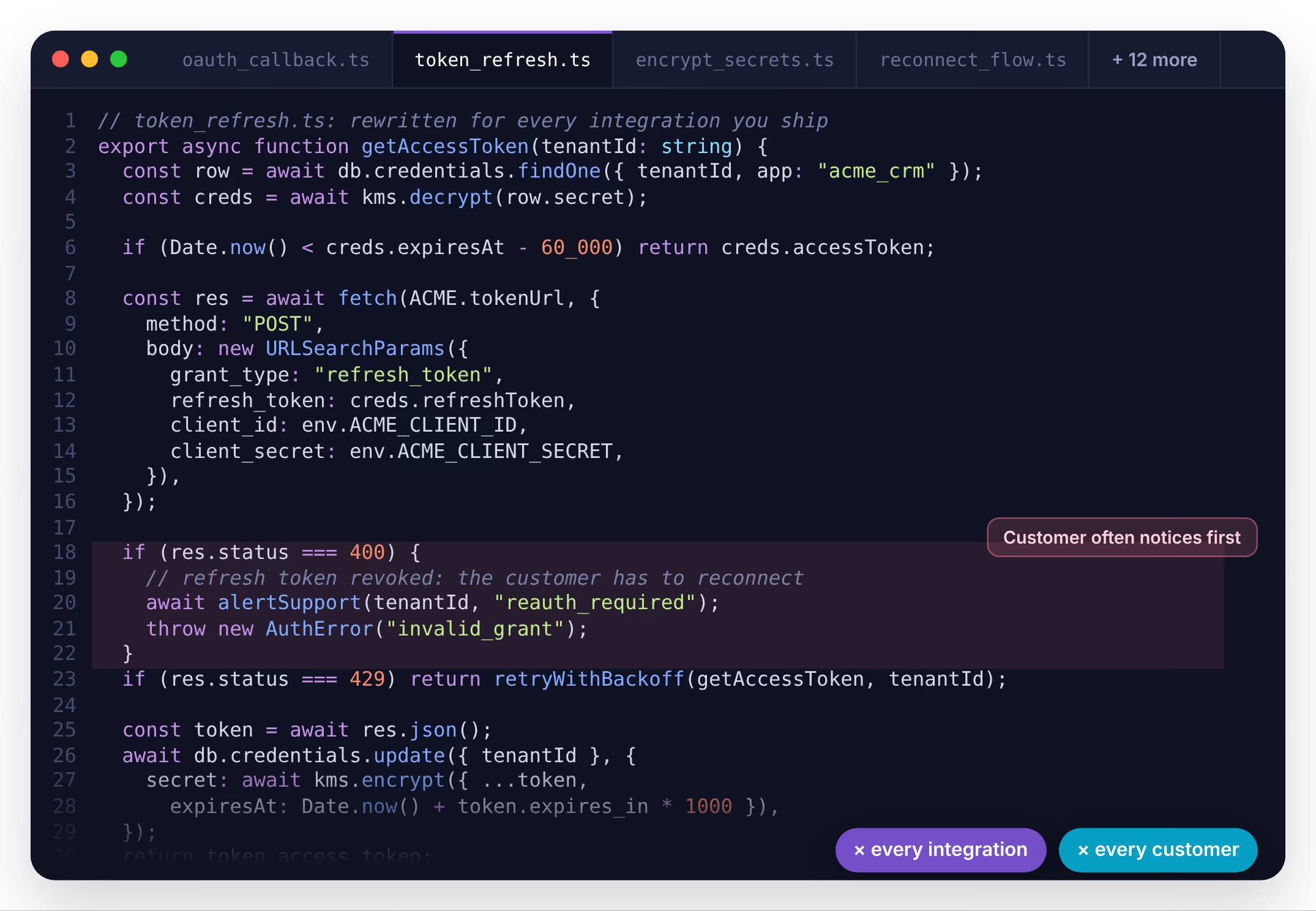
Auth is the part of an integration that never stays done. Every app authenticates differently, every customer has their own credentials, and every token eventually expires. Multiply that across dozens of integrations and hundreds of customers, and auth becomes a significant engineering cost.

A failed refresh quietly stops a sync. Storing third-party secrets puts encryption and audit scope on your team. And walking customers through setup turns into support tickets.
GitHub repository named acme_to_salesforce showing folders for multiple languages and a code snippet with pipenv commands for Python Salesforce integration.

How does Pandium manage authentication for integrations?

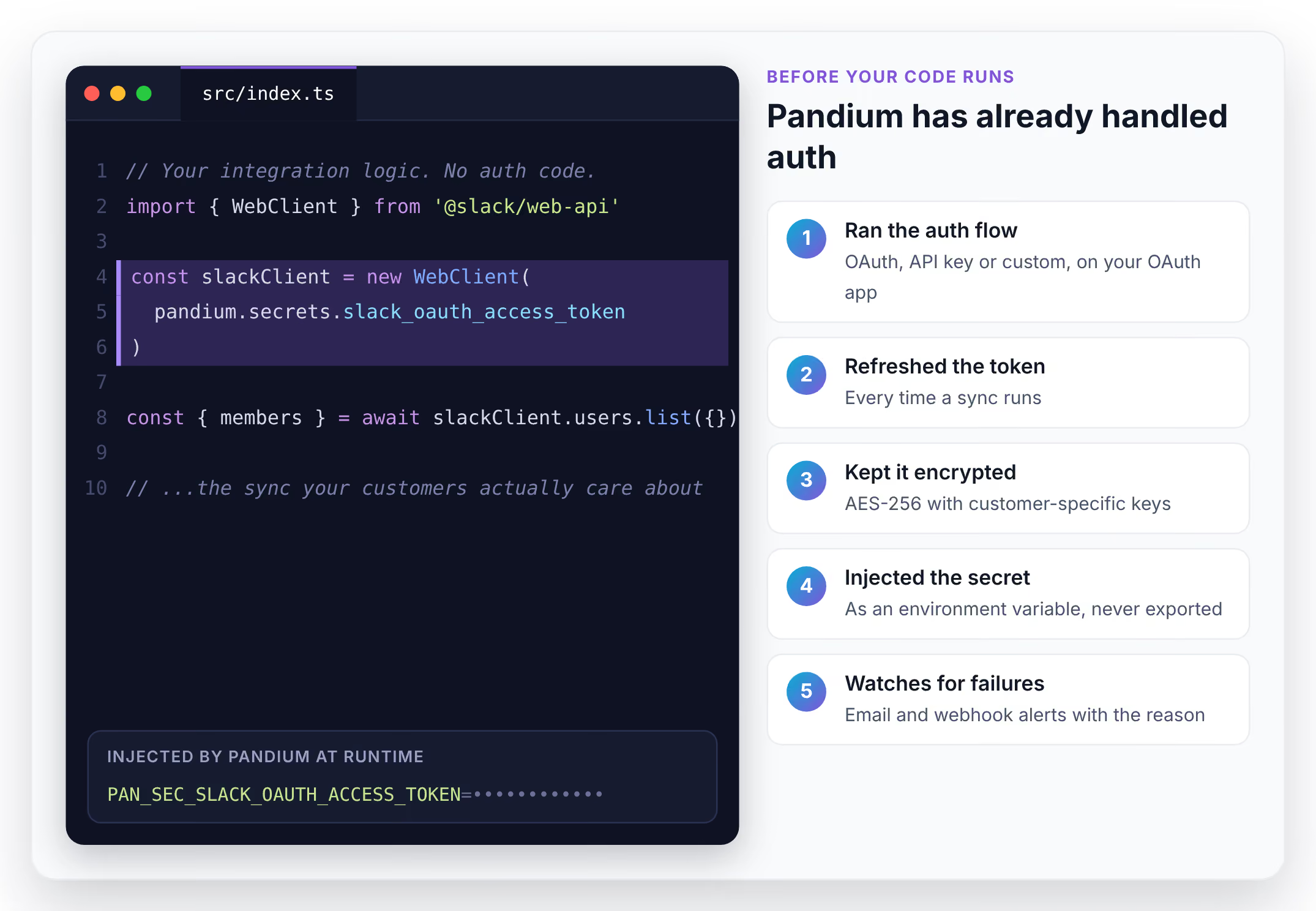
Pandium connectors own the auth layer. They stand up authentication endpoints, generate and refresh tokens, store credentials encrypted, and pass them to your integration code at runtime. Your code never handles a raw OAuth flow.
GitHub repository named acme_to_salesforce showing folders for multiple languages and a code snippet with pipenv commands for Python Salesforce integration.

Auth flows that fit your product

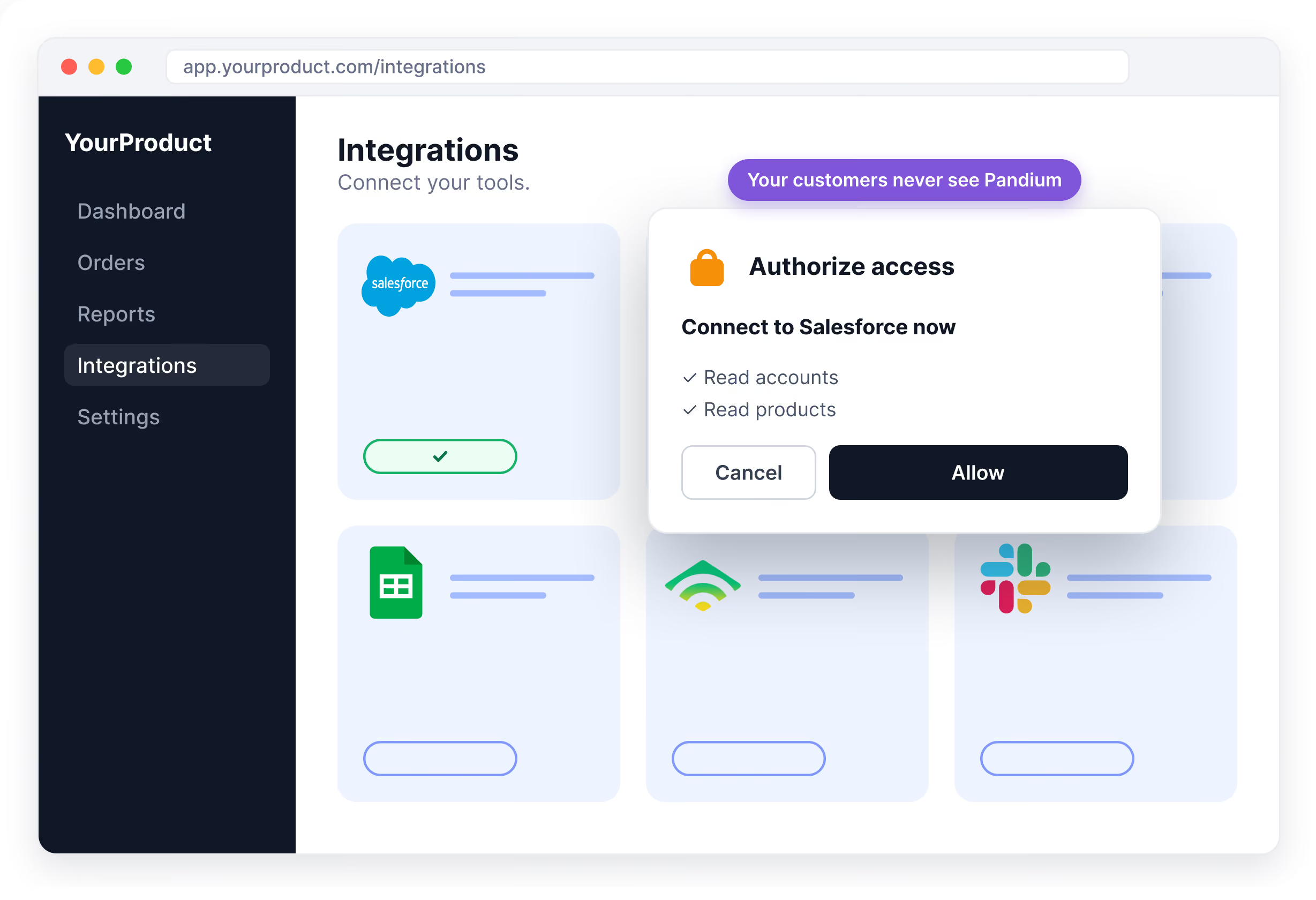
Let customers connect from a branded In-App Marketplace, send an Auth Link for one connector, share a Magic Link that needs no Pandium account, or embed an auth-only page in your app.

Customers connect on their own, and support teams can reconnect a tenant without an engineering ticket.
GitHub repository named acme_to_salesforce showing folders for multiple languages and a code snippet with pipenv commands for Python Salesforce integration.

"Pandium takes care of everything—from authentication onward—so we can stay focused." — Verified G2 reviewer

What you can offload with Pandium

Auth task Building it yourself With Pandium
Auth methods Build each OAuth, API key or custom flow by hand Connectors support OAuth, API keys and custom or proprietary methods (docs)
OAuth app and branding Register the app, then build and host the flow Your OAuth app stays in your own developer account; Pandium runs the flow on it, so customers see your brand, not Pandium's
Token refresh Write and monitor refresh logic per app Pandium refreshes OAuth tokens each time a sync runs
Failure alerts Build your own monitoring Email and webhook notifications on failed runs, with the reason, including connection and refresh errors
Credential storage Design encryption, key management and access control AES-256 encryption, customer-specific keys for OAuth tokens, TLS 1.3 in transit, credentials never logged (security)
Passing secrets to code Fetch and decrypt in your own services Secrets arrive as environment variables at runtime and cannot be exported
Per-customer vs shared credentials Build tenant isolation yourself Secrets set per tenant or globally
Coverage One integration at a time 200+ pre-built connectors; new ones built free, typically in 1–2 days (connectors)
Compliance Audit scope grows with every stored credential SOC 2 Type 2 certified; isolated execution per integration

The auth layer behind every integration you launch

Infinity loop made of pink and red gradient curved lines on a transparent background.

Any Auth Method

OAuth, API keys, and custom or proprietary methods, across public and private APIs, SFTP, and databases.

Infinity loop made of pink and red gradient curved lines on a transparent background.

Token Refresh

Pandium refreshes OAuth tokens each time a sync runs. No refresh logic to write or maintain for each app.

Infinity loop made of pink and red gradient curved lines on a transparent background.

Credential Security

AES-256 encryption, customer- specific keys, TLS 1.3 in transit, and no credential logging. SOC 2 Type 2 certified.

Infinity loop made of pink and red gradient curved lines on a transparent background.

Failure Alerts

Email and webhook notifications on failed runs tell you why, including connection and token refresh errors.

Infinity loop made of pink and red gradient curved lines on a transparent background.

Your Brand, Your OAuth App

Your OAuth app stays in your developer account. Customers see your brand on the consent screen, not Pandium's.

Infinity loop made of pink and red gradient curved lines on a transparent background.

Secrets at Runtime

Credentials reach your integration code as environment variables at runtime, set per tenant or globally, and can't be exported.

See How Pandium Accelerates Integration Development.

Schedule a demo to see how Pandium helps B2B SaaS teams build, launch, and manage integrations—faster, with more control, and without the infrastructure headaches.
Thank you! Your submission has been received!
Oops! Something went wrong while submitting the form.
Support

FAQs

Common questions about how Pandium
handles authentication for your integrations.
Browse all FAQs →
What does it mean to offload auth management for integrations?
It means a platform runs the authentication layer between your product and your customers' third-party apps. With Pandium, connectors handle OAuth and credential flows, store secrets encrypted, refresh tokens and pass credentials to your integration code at runtime. Your team writes only the integration logic.
How does Pandium handle OAuth token refresh?
Pandium refreshes OAuth tokens each time a sync runs and stores them with customer-specific encryption keys. Your integration code receives current credentials as environment variables, so you don't write refresh logic for each app.
How do I know if a customer's OAuth connection has expired or failed?
Pandium sends email and webhook notifications when a sync run fails, and the alert states the reason, including connection or token refresh errors. Each customer's connection status is visible in Pandium, and your team can reconnect it by sending the customer a new auth link.
Which authentication methods does Pandium support?
Pandium connectors support OAuth, API keys and custom or proprietary auth methods. They also cover private APIs, SFTP, cloud storage and direct database connections. Credentials can be set per customer (tenant) or once globally for all tenants.
How are customer credentials stored and secured?
Third-party credentials are encrypted with AES-256 and travel over TLS 1.3 or later. Decryption key access is limited to the relevant tenant, credentials are never logged, and secrets cannot be exported. Pandium is SOC 2 Type 2 certified, and each integration runs in an isolated environment.
Do my customers need a Pandium account to connect their apps?
No. Customers authenticate through your In-App Marketplace, an Auth Link, a Magic Link or an auth page embedded in your app. They never need a Pandium account, and with embedded auth-only connections they never see Pandium at all.
Who owns the OAuth app: my company or Pandium?
You do. Your OAuth app and partner developer account stay with your company, and Pandium runs the auth flow on top of them. That keeps the partner relationship yours and white-labels the experience: your customers see "App by [your company]" when they authenticate, not Pandium.
API key or OAuth: which should my integrations use?
That depends on what each third-party app offers, and Pandium supports both. OAuth gives customers a consent flow and scoped, revocable access; API keys are simpler but long-lived. Pandium connectors handle whichever method each app requires.
What if Pandium doesn't have a connector for the app I need?
Request it. Pandium builds new connectors free of charge, typically in 1–2 days. The connector handles auth and webhooks; your integration code handles the rest.
If Pandium handles auth, do I still own my integration code?
Yes. Pandium is a code-first embedded iPaaS. Your integration logic lives in your own repository, while Pandium runs auth, hosting, logging and monitoring.

The Product & Engineering Guide to Choosing the Right Integration Platform

Choosing the right integration platform can make or break your SaaS product’s ability to scale, meet customer demands, and maintain flexibility. This guide walks through key technical and business considerations to help you evaluate solutions based on architecture, customization, scalability, and long-term maintenance.