The Vibe Coding Phenomenon: What Happens When Everyone Becomes a Developer?
AI may make building software easier, but maintaining it is still hard.
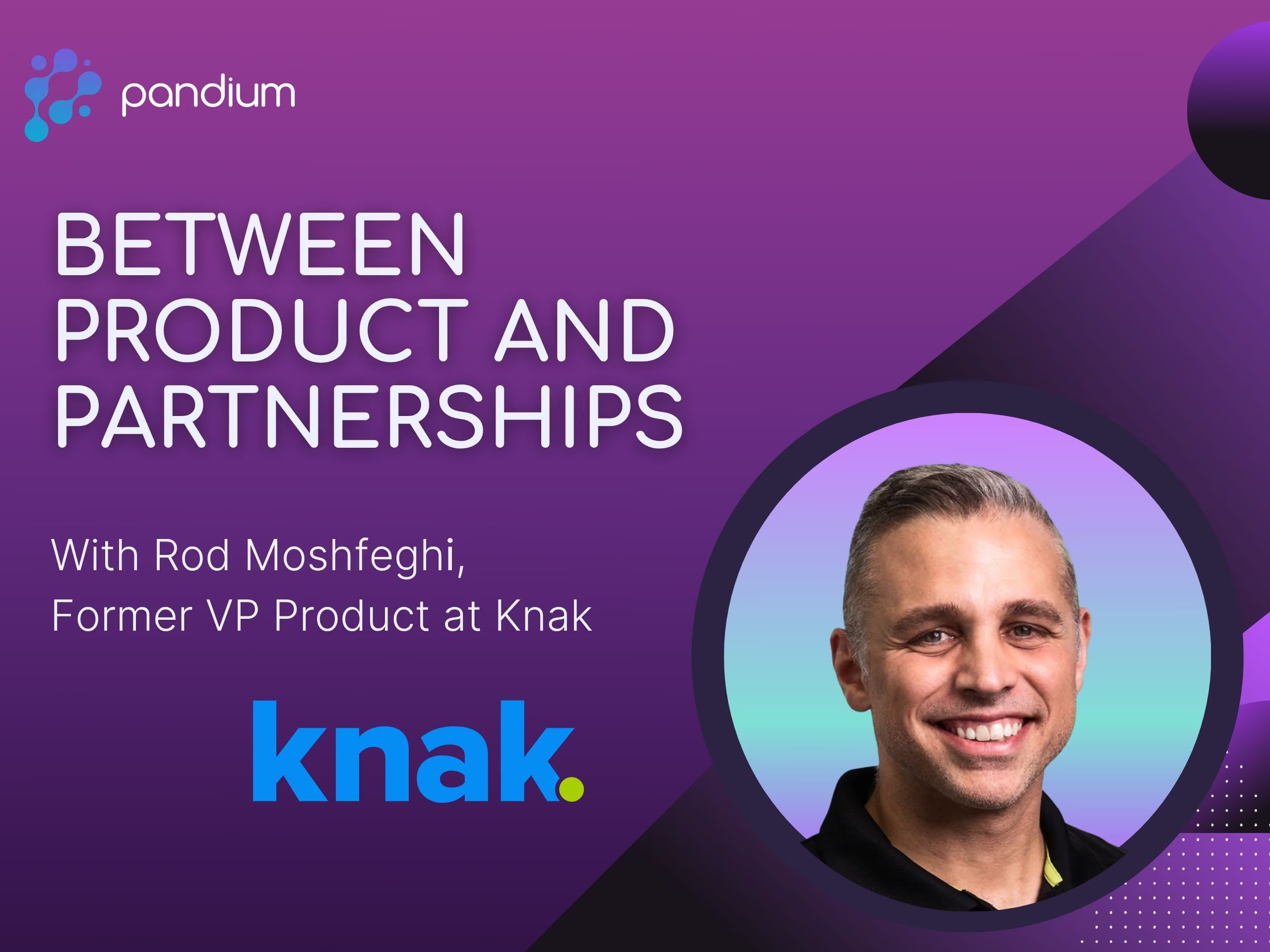
In this episode of Between Product and Partnerships, Cristina Flaschen sits down with Rod Moshfeghi, former VP of Product at Knak, to discuss what is actually changing in the API and integration world as AI tools become more accessible.
Drawing on experience across IBM, Layer7, Hootsuite, and Knak, Rod reflects on more than a decade of working with APIs, developer ecosystems, and technology partnerships. Together, he and Cristina explore why many of today's trends are less revolutionary than they appear, and why engineering fundamentals like scalability, resilience, governance, and maintenance remain just as important as ever.
The conversation examines the rise of vibe coding, MCP servers, and citizen developers, but also the realities that emerge once software reaches production. From race conditions and platform dependencies to shadow IT and internal app sprawl, Rod argues that the hardest problems in software have not disappeared. Instead, they have become accessible to a much larger audience.
Who We Sat Down With
Rod Moshfeghi is the former VP of Product at Knak and has spent more than a decade working in APIs, developer platforms, integrations, and partner ecosystems. His career includes leadership roles at IBM, Layer7, CA Technologies, Hootsuite, and Knak.
Rod brings expertise in:
- Building API-driven products and developer ecosystems
- Managing platform partnerships with large technology providers
- Leading product teams in marketing technology environments
- Balancing innovation with long-term maintainability and governance
Key Topics
What feels genuinely new in the AI era
While technologies like MCP servers are receiving significant attention, Rod argues that many of these concepts are extensions of existing API patterns. The truly new development is not the technology itself, but the number of people who now expect to interact directly with software infrastructure.
Why the final 10% is where engineering matters
AI tools can dramatically accelerate development, but reliability, concurrency, persistence, and scalability still require deliberate engineering. The work that makes software production-ready often represents a disproportionate amount of the effort.
The rise of non-traditional builders
Marketing teams, operations teams, and business users are increasingly building their own workflows and applications. This democratization creates new opportunities, but it also introduces new expectations and challenges for product organizations.
Lessons from platform dependencies
Having worked closely with large ecosystem players, Rod discusses the importance of understanding where partnerships complement your product and where they overlap. Strong differentiation becomes critical when partners can also become competitors.
Maintenance as the real moat
Building software is only the beginning. Ongoing maintenance, adapting to changing APIs, and supporting evolving ecosystems often become more valuable than the initial implementation itself.
Shadow IT and governance challenges
As internal applications proliferate across tools like Replit, Cursor, Claude Code, and Vercel, organizations will need new approaches to governance, ownership, and standardization.
Distribution becoming the next bottleneck
As companies release more products and features faster than ever, attention becomes scarce. Rod argues that enablement and distribution may become more important than the underlying technology itself.
Episode Highlights
07:00 — Why API complexity has gradually become easier to consume
10:50 — Rod's experience building with MCP and where the challenges emerged
12:00 — Discovering that race conditions still exist in an AI-assisted world
15:00 — Why resilient software design matters more than typing code
16:40 — Lessons learned from platform dependencies at Hootsuite
18:30 — Understanding where partners complement and compete
20:10 — Why maintenance becomes the real differentiator
22:20 — The impact of employee turnover on technical debt
25:20 — Shadow IT and the coming wave of internal application sprawl
29:00 — Why organizations will eventually consolidate AI tooling
33:00 — Rod's advice for product leaders building with APIs and AI
34:10 — Why distribution and enablement may become the next competitive advantage
Key Takeaways
1. AI lowers the barrier to building, not the complexity of operating
Generating code is easier than ever, but software still needs to scale, recover from failures, and remain reliable over time.
2. Engineering fundamentals have not changed
Concurrency, persistence, sequencing, and system design continue to define successful products regardless of how the code was created.
3. Maintenance is often more valuable than initial development
The cost of keeping software current across changing APIs and ecosystems frequently exceeds the cost of building it in the first place.
4. Partnerships require clear differentiation
Companies must understand where they complement larger platforms and where feature overlap could create competitive tension.
5. Governance will become increasingly important
As more employees create their own applications and workflows, organizations will need better standards, visibility, and ownership.
6. Technical debt now belongs to everyone
When more people build software, more people also create technical debt. The challenge shifts from creation to long-term stewardship.
7. Start with the problem, not the technology
Whether using APIs, AI, or traditional development approaches, the best products focus first on the job customers are trying to accomplish.
8. Distribution may become the next constraint
As software creation accelerates, helping customers understand, adopt, and derive value from products becomes increasingly important.
Connect with the Speakers
Connect with Cristina: www.linkedin.com/in/cristina-flaschen/
Connect with Rod: www.linkedin.com/in/hirbod-rod-moshfeghi/
Learn more about Knak: www.knak.com
--
This podcast is hosted by Pandium, the only embedded integration platform that facilitates faster code-first development of integrations, allowing B2B SaaS companies to launch integrations at scale without sacrificing customization and control.
Learn more about Pandium here: https://www.pandium.com/
To access more resources and content on technology partnerships, integrations, and APIs, check out our blog and resources page below.
Blog: https://www.pandium.com/blog
Resources on Technology Partnerships, Integrations, and APIs: https://www.pandium.com/ebooks
Podcast Transcript
Sarah Elkins (00:00)
Welcome to Between Product and Partnerships, a podcast focused on bringing together product, partnership, and engineering leaders to discuss how to build, support, and scale SaaS ecosystems. This podcast is presented by Pandium, an integration platform for building native integrations.
Cristina Flaschen (00:19)
Hi, everyone. Thanks for listening to our podcast between product and partnerships, where we talk about the challenges and what it takes to build integrations, tech partnerships, and SaaS platforms. And today I am so excited to have Rod Mashvegie, former VP of Product at NAC, join us on the podcast. Thank you so much for spending some time with us. ⁓ and can you share a little bit about yourself and your background with our audience?
Rod Moshfeghi (00:43)
Perfect. Thank you, Cristina. Great to be on the podcast here. ⁓ Rod, former VP of product at Knak been in the API.
partnership data game for a number of years now, taking me from IBM to layer seven, which is was a kind of one of the OGs in the API management, API gateway space to CA technologies to Hootsuite, which is I would say one of the OGs in the third party developer space, especially working on the social media platforms, all the way to my recent last four years at Knak working on again APIs and integration specifically with various components of the Martech stack. That leads me to today here with on this podcast.
Cristina Flaschen (01:21)
Amazing. You've had such a great and varied background. And ⁓ as a as a former OG API consumer, you've been working with APIs and integrations since around 2011. So I'm curious from your perspective, and you worked at a middleware company, ⁓ how the middleware world has changed to adapt to today's API economy where everybody is using APIs for everything.
Rod Moshfeghi (01:46)
I think one of the biggest things that's happened is simplicity has definitely come in. The idea of keeping things simple, making things easy to onboard, really focus on that versus previously it was focused on really data consistency and almost like the engineering practice. So the best example is, you know, I say the word whistle and I get blank stairs now because that was such a relic of a previous era where it was really all about really, really thorough, pro really well done technology, really.
well done specs and the move to open apis rests and simplicity and the ability to get up and running. And now the move to MCP in the agentic world is just turning that on its head. Basically, you know, we used to say the term citizen developer now has truly the case. It's capital C, lowercase D, where everybody can develop and vibe code through all the the LLMs and the Frontier models. So it's it's I've really seen that progression and more and more
more folks are familiar with the concept of APIs and that infrastructure that sits behind it. Versus in the past, again, it was just something that they weren't familiar with. Or again, I get blank stares when I brought up soap or whistle or things of that nature.
Cristina Flaschen (02:54)
Even I used the the term like crud functionality not that long ago to somebody and they totally had no idea what I was talking about. And I was like, you know, I maybe that's like an old school term, but I will say I still interact with a lot of APIs that do not have full crud functionality. And I'm like, we need let's go back. Let's go back to basics. ⁓ and with that in mind, like my team and
Rod Moshfeghi (03:02)
Ha ha.
Mm-hmm.
Yes. Yes.
Yes.
Cristina Flaschen (03:17)
people that I know in my personal life have heard me talk a lot about the rebranding of technology over time where it's like wait there's these kind of common concepts, but obviously with AI, we have all this new stuff too, and new nomenclature and kind of language around that. To you, like what about right now feels genuinely new? And what is like a rebrand or sort of a an it's all an extension of fundamentals, but what do you what do you think is actually new and novel versus just a new name for an old concept?
Rod Moshfeghi (03:46)
Yeah, I mean, I find MCP and MCP servers are kind of a rebrand of an older concept. You know, it'll like we especially at Knak, we had some customers before, you know.
months ago because this is also like new, but you know, like late last year, they were already integrating their agents, so agentic workflows with our product using our public API. So this is before our plug alert, our new MCP server that was released about about a month and a half ago now. But they were they were already integrated. So they were just using our open API and going from there. So I do find the concept of MCP server at times is a bit of a rebrand of original open APS because you can kind of replicate similar things.
What I do find new is just more folks are involved, more folks are are able to work with different products, and more folks expect the ability to be able to work with them. They expect to be able to sit in Claude, in Claude Code, in Codex, in Chat GPT, and be able to interact with these different SaaS products using integrations versus before they it was a concept they did it it was it just wasn't top of mind for them or it was it wasn't it was something that intimidated them to be honest. And when I say more folks, I mean
more folks working in the enterprise in traditionally non-super technical roles. So non-developers. ⁓ starting to see the shift though. Like I've seen the shift from developers to non-developers, but still tech. And this is where, especially Martech, we see a lot of technologists that don't necessarily have that traditional computer science development background. And now we're starting to see it getting more and more into folks that are even further away from us. So folks that weren't used to setting up infrastructure, work folks that weren't setting up like databases, more on the brand creative side, or again.
Cristina Flaschen (04:59)
Mm-hmm.
Rod Moshfeghi (05:24)
Starting to expect these integrations. They're by coding a little bit themselves and they're just expecting these kind of API integration points that are really hiding behind the MCP servers to be there.
Cristina Flaschen (05:33)
I'm curious, and maybe this is like a spicy question, but in your role as leading like product orgs, how do you or do you see any friction being introduced with folks that are slightly less technical, having an expectation of things working in a specific kind of way? And I think ⁓ the reason that I ask that is, you know.
Vive coding is a great example, right? Like you can get from like zero to like 90% really fast, but that additional 10% is maybe where you're gonna really hit a wall. And I could imagine in a product org, especially if you're in Martech, and I think marketing and marketing ops people are crazy tinkerers, like more than a lot of B2B sort of users, I think. Like I could imagine there's a lot of pressure to like, it needs to be this must be easy. Like do it fast, do it now, do it perfect. And then that sort of the flip side of that is like you as the product manager being like maybe.
We need to temper our expectations a little bit about what is possible. I'm curious if you've run into that. I feel like with to your point, with this influx of new, less traditionally technical users, I see more of this friction coming up, but I'm wondering if you've experienced the same thing.
Rod Moshfeghi (06:30)
Yeah.
It's kind of been the world I've been living in for ten years, to be honest. Because because and it and it's and you're right, it is it is exponentially growing and it's an ongoing saga, I would say.
Cristina Flaschen (06:44)
Ha ha
Rod Moshfeghi (06:53)
So the reason I say 10 years is I spent between 2016 and 2022, I spent six years at Hootsuite. RICP was folks in marketing, but social media marketers. And it it was it was challenging at times to kind of have conversations with our customers where we would say, I know you see this functionality in Meta or in a user interface in LinkedIn, but it's not on their API. And we get these kind of looks of like, well, what do you mean?
Like it's just to say you should be able to be in your user interface. And we'd have to kind of break down that, like kind of really explain the technology difference there and then, you know, the concept of API first or or not and all that. So that but that was that was kind of in that world. Once I moved over into more of dealing with mops folks, like you marketing operations folks and and my tenure at Knak between 2022 and and up until recent, ⁓ it was a little bit mm it it was a little bit of an easier conversation because I think folks understood, that there's this API thing.
Cristina Flaschen (07:28)
Yep.
Rod Moshfeghi (07:48)
It's different. It's a different interface. But now as we get more and more folks vibecoding and starting to kind of see the world of technology being easier, again, they're like, well, I this sh this all should just be easy and it should be that. What do you mean it's not in your API? Or what do you mean it's it's not already done? And so it's been, it's an ongoing thing to really, to really iterate or really to reiterate that ⁓ that last 10% is not 10% of time.
Cristina Flaschen (08:17)
Mm-hmm.
Rod Moshfeghi (08:17)
Necessarily.
It's 10% of functionality that actually makes this thing tick. And I it it's been an ongoing thing to be able to explain to folks and be like, that's what separates you using this vibecoding product and 10,000 people being active on it at the same time is that 10% and the ability to scale it and have underlying proper infrastructure and all that. And so it is an ongoing thing. I don't have a silver bullet right now. I just know it's a constant conversation that we're having and it's just happening more and more and more now. I think.
What what I'm hopeful though, because I've seen in these situations as folks are going through it and as they go from zero to ninety really quickly, and as they try to go from 90 to 100 and it takes way longer, they do appreciate how difficult it is. And so like I think in six months, a year's timeframe, we're gonna get kind of a a different perspective from folks where they're like, yeah, this is actually hard. This is hard.
Cristina Flaschen (09:11)
for sure. I think it's gonna normalize a hundred percent. It's just it's been I was reflecting on this like a couple of days ago where
For many years, and by many years, I mean 15 years, 20 years, there was this idea that like software engineers are this like mythical kind of beast. It's like super, it's super difficult. This is a highly specialized skill. These people are geniuses and like no, you know, super expensive, really hard to hire, da-da-da-da-da. And now, over the last like two to three years, especially with the vibe coding stuff, it's like that's been flipped to the polar opposite, where it's like, we don't need engineers, everyone can do it. And like it was just, it was this piece of technology I think that really caused that.
Rod Moshfeghi (09:26)
Yeah.
Okay.
Cristina Flaschen (09:48)
hard pivot. And it's just it's interesting to think about like, I think both of those are not correct, right? Like there's nuance there and the the truth is somewhere in between, but like this impulse to be like
You know, we've gotta pay engineers a bajillion dollars. We can't give things to the engineers, like their time is so sacred, and now it's just like who needs them? I'm like, that is like some serious whiplash. ⁓ in a world where like, you know, AI and generative coding is obviously super helpful, but like the underlying technology that runs all of this stuff has not shifted in a meaningful way, right? So like the the issues that make a great engineer a great engineer and make it a specialized skill are still still remain. Those challenges are still there, right? but I do love the sort of
Rod Moshfeghi (10:05)
Yeah.
Cristina Flaschen (10:28)
leveling out of the playing field a little bit more. Like any, I've said it on this podcast a ton of times, like anytime access to technology can be democratized in some way and we can allow more people to ex like have a positive experience and be empowered with tech, I'm all for it. but it is like an interesting I'm sure as a PM, it can be challenging to now be treat now be servicing essentially an entirely different set of users.
Rod Moshfeghi (10:55)
Yes.
Yeah. An entirely new set of expectations. I think you're bang on and and I actually kind of catch myself sometimes too. So I I you know, story time. ⁓ recently, so you know, it kind of when we announced MCP server at Knak, one of the big things was we announced it with a at a talk that OpenAI gave with us, and they were talking about how they use portion of our MCP server to automate a certain workflow that they had going through Slack and integrated with linear and a bunch of other things there.
Cristina Flaschen (10:57)
Yeah.
Rod Moshfeghi (11:22)
One of the big things for me as I was sitting in the audience, this was at Adobe Summit. As I was sitting in the audience and I was seeing everyone and their eyes lit up because they understood, hey, I could build that. And so it was really cool. So I got personally got inspired. I'm like, I'm gonna go and put this together. Like, how hard can it be? I can vibe code something in codex I can like, you know, or to just vibe code it just in plain chat GPT, run it as an agent, hook it into Slack all that. One of the things so I got from zero to 90 really quickly. I got things hooked up in Slack.
What did that last 10% though? And and the part where I'm like, this is easy. And it's still this easy to get to that point. But that last 10% where I was like, yeah, this is hard. And the expectations that I have of our engineering team sometimes when they're like kind of slow at something, I should temper that because I started running into race conditions. Ones that and you need, and like, you know, I haven't I used to be you know, I ran DevOps teams, like I
Cristina Flaschen (12:07)
Mm-hmm.
Rod Moshfeghi (12:12)
I used to write like DevOps tool train. I used to J J2E developer, build data warehouse. I'm like, I'm technical enough. Like I can write Java, I code in various scripting languages and all that. So I understand I've designed architectures before, but it was one of those where I'm like, okay, it's not just me telling, you know, an LLM, hey, put these things together. I have to really be very, very prescriptive about you know the sequence. And I have to actually build a sequence diagram and be very careful about the information that gets passed and where things get persisted.
Cristina Flaschen (12:35)
Mm-hmm.
Rod Moshfeghi (12:41)
And then the interface for that persistence. And I'm like, you know what? Sure. Software engineering and the software part, which traditionally was coding, maybe that is democratized, but engineering is about to get amplified because I kept I kept creating issues where I was creating race conditions and I couldn't figure out how to debug them. And I'm like, you know, like you need to kind of step back and like write this out and create diagrams and all that and to like really figure out what to do. Eventually I figured it out, but it wasn't as trivial. And that was that kind of like last 10% where I could.
Cristina Flaschen (12:42)
Yeah, yeah.
Mm-hmm.
Rod Moshfeghi (13:09)
then give it to my team not only to be like, look at this fun shiny thing, but this is actually a process we could use for like ingesting certain requests coming into our org via Slack. In this case it was for email generation, but it could have we're gonna start using it for product requests coming in as well. Too we're tinkering with that.
Cristina Flaschen (13:24)
Yeah, yeah.
I find like a lot of that 10% that we're that we're referencing, I in my mind frame that as like resiliency. And I think of like the race condition stuff, concurrency, like the ability to pick up where you left off, like caching, cursors, all this stuff, like kind of falls in that 10% that like if you're only trying to get one record from here to here, and we do integration stuff all day. So like this is all I've been thinking about for 20 plus years. But like, you know, if you just have one record going from, you know, Reddit to Slack, like you good.
Rod Moshfeghi (13:34)
Yes.
Cristina Flaschen (13:56)
But if you're trying to do 20 or 200 or 200,000, maybe you're not so good. And if it's really important that that they all make it over a period of time in order, as you were mentioning, like Slack messages are time sensitive in a lot of ways. They have to be processed in order. ⁓ that's where you start to get into to your point, like these comp sci kind of fundamentals. And it's
I totally agree with you. I think that like software design in terms of not just the UX, but the, you know, the actual design of resilient, like scalable software is gonna become even more important as like the hands-on keyboard typing ⁓ is less important. But ⁓ as as you were telling that story and saying that it was like a talk on stage, I got like a sense of anxiety because I was like, God, tell me he didn't go up there and try to do this live because like that
Rod Moshfeghi (14:43)
No, no, no.
Cristina Flaschen (14:44)
I'm like, no, no, not the live demo. No.
Rod Moshfeghi (14:45)
No, I mean I mean, you know, for hopefully listen, shout out to Jeff Canada. He he could have he could have pulled it off. Like he's he's good at that, but
Cristina Flaschen (14:52)
Sure.
Rod Moshfeghi (14:54)
It was if he didn't do it, but no, that would have been a thing. I mean, I was thinking I'm like, I could do this live. And then once I got into it, I'm like, ⁓ okay. Yeah, because it was one of the interesting things is again, again, you need to start doing system design a little bit of like, okay, what's the context my that I built an agent here to be able to do a bit of a ⁓ of a handshake between the two protocols. Surprise, surprise. It's kind of something that you probably have to deal with on a day-to-day basis. But it was and it was which context is it in? And then it would lose the message or it persist it in the wrong place 'cause I had to
Cristina Flaschen (15:06)
Mm-hmm.
Rod Moshfeghi (15:23)
do something in, you know, the an open API in the, you know, Chat GPT infrastructure. It had to do something with regards to Knak and its MCP server and then to do something in Slack. And sometimes you just get lost. But that's the thing about I think a lot of citizen developer types are gonna find out really quick that they need to go learn that stuff pretty quick because you're right. The underlying infrastructure hasn't changed. It is it is still the same, you know, a times ball of twine that sits underneath it. So yeah.
Cristina Flaschen (15:48)
Yes. And we are it's
like all zeros and ones. And despite the models being cool, like we're all still bound we're all still bound by like physics and like the speed at which things can happen. And but it's it's cool. I mean it's it's definitely snazzy. I'd love to see what you guys have have used. We could take it offline, but like what how that ended up working out. ⁓ and you you referenced, I think a little bit ago, talking about
Rod Moshfeghi (15:51)
Yeah.
Yeah, yeah.
Sure. Yeah.
Cristina Flaschen (16:12)
LinkedIn, like it's in the UI and why can't I access that? There's no APIs in LinkedIn, don't at me, but is like notorious for that as a company. but I'm curious because you've worked with a lot of companies that I think especially Hootsuite that is very dependent on that third party. And a lot of our listeners, I think almost every ecosystem has that big fish fish, little fish sort of thing. There's like the Shopifies, there's the Salesforces, there's the Twitters. ⁓
Rod Moshfeghi (16:20)
Yeah, yeah, yeah.
Cristina Flaschen (16:37)
I'm curious what lessons you learned about like platform dependencies in working with those big kind of players.
Rod Moshfeghi (16:44)
It oof, yeah. It's, I mean, I know you recently had another podcast, yes, talking about partnerships and like the big fish, little fish, and like the the conversations there. It's yeah, it's I it it's tricky. It's all it's arguably when you set out down this path, especially when you're going down the partnership path, you have be very thoughtful about this. I think the big thing is go into it with the research of where do we complement each other and where do we compete? Because odds are there's likely some level of competition occurring.
During the Hootsuite era. And I'm sure I I know you had one of my ex-co actually two, two times ex-coworker, Bilijana that you had on the podcast. And I know she was talking about some of the kind of the the fun stories of of Hootsuite era. ⁓ but part of it is a lot of times they you know, because they're a partner, they open up these APIs, but the reason they're useful to you is they probably have some flavor of your functionality within their products. So you have to really, really be careful and do some analysis there of where do we complement, where do we compete.
Cristina Flaschen (17:38)
Mm-hmm.
Rod Moshfeghi (17:44)
And also, what's our moat against them? Because you need to be prepared, even though you have a business relationship and your partners, that there could be a situation where a customer isn't or a pr potential, let's just say prospect, even an existing customer, isn't is looking at y'all as, you know, two compliments together, you're their joint customer. But at some point it could be looking at y'all as competitors of like, what if I want to do platform consolidation? Can I take one of them away? And this was, you know, with with at Hootsuite especially with the social media networks, we it was
Cristina Flaschen (18:04)
Mm-hmm.
Rod Moshfeghi (18:13)
it was challenging at times, especially when one moat, which was it was a little bit like I should have the the the old school moat of of who suite was omnibox, where it's like you create once and be able to share across multiple networks. ⁓ where that kind of didn't or at times it it changed because the social media networks changed and it was just basically different audiences on different networks. So you weren't necessarily sharing something on Twitter as it is on on Facebook or Instagram. So you had to be very careful of what is our moat there, especially now we're competing kind of like directly with those.
Cristina Flaschen (18:21)
Mm-hmm.
Mm-hmm.
Yeah, yeah.
Rod Moshfeghi (18:42)
I know it's interesting because at Knak, like again, similar things do come come up with the marketing automation platforms when we work with them, where sometimes the the feature sets overlap so much that almost they seem like competitors. But and that's where you got to really, really lean in and be like, this is actually what's unique with our product. Like we have a really robust way for you to define a design system, or we have a really robust way for you to do collaboration that you wouldn't necessarily do in these other products that we still think are great for like managing leads or managing or sending things out. So you just I think
more and more, you do have to kind of step back a little bit beyond the tech and look at the business side and honestly the the customer's jobs to be done. So I I've I I was wondering how long it would take me before I reference the GTBD framework, but really like what is that and where does this overlap? So that's that's kind of it's it's an interesting, it's tricky, but you do have to pay a lot of attention to it.
Cristina Flaschen (19:31)
And how do you think about that type of differentiation and also identifying like the problem set that you want to build against in a environment where hypothetically there are people trying to build their own stuff. So like they know their problem really well, wait you hope, and they are building their own thing.
Rod Moshfeghi (19:50)
Yeah.
Cristina Flaschen (19:54)
and I have a lot of opinions about this, which you people can find on my LinkedIn if they want. But I'm curious from from your vantage point what you what you think about that.
Rod Moshfeghi (20:02)
It's it's you know, and and pre so this was it really interesting in AC because pre ⁓ even pre like you know everyone says November 2025, you know, when some of the the the the kind of the more exciting and models from anthropic came out and everyone became a vibe coder. ⁓ even pre that a lot of Knak's customers would try to build their own in-house versions of Knak and what they would slowly find, and this is what kind of becomes the moat and I think what a lot of folks have to really be careful is the maintenance that lasts 10%.
That kind of more and more becomes your moat because you can always get from zero to 90. Previously, you just have an engineering team, they spend, you know, like 12 weeks up to like a year building something. And then, but that's it doesn't end there. And a lot of like our a lot of folks would be like, okay, we're done. But then they would find out later that you have to maintain this, and especially as things change, both in terms of third-party APIs, but even downstream for the the APIs in in the email world. It's like the the email clients and all those downstream as they change. You have to change. So
That's kind of the thing, is really our our thing was what is our what is our unique value differentiator? And also what do you get when we say maintenance and an ongoing SaaS business? At the end of the day, we have folks whose whole job is to make sure your the product doesn't break, but also stays up to date with the entire ecosystem. And that is a huge cost. Arguably that is more of a cost than almost a disincentive for building your own thing and then maintaining it over time.
That that's I think the big reckoning that's gonna happen in six to twelve months from now is everyone's gonna realize software is really expensive to maintain and it almost for those that went from the hosted to the cloud world, it's it's a bit of you know, it's it's kind of bit of a chuckle. We've seen yeah, exactly, exactly. And it's like we've seen this play out. You're gonna find out, you know, like it's like it's these things are hard to maintain, things change and
Cristina Flaschen (21:44)
We've seen this movie.
Rod Moshfeghi (21:56)
that's why you you know, some people get big big bucks to just keep an eye on them and and roll with them. So yeah.
Cristina Flaschen (22:01)
Yeah, it is ⁓
I agree with everything you're saying and like it's also interesting, I I do feel like back in the, you know, the on-prem or like the the kind of legacy software world where everyone was building their own stuff and then we moved to s the cloud and SaaS and all that, people also stayed at companies longer. Like
You could have somebody that built your in-house pricing engine for whatever and that person is with you for forty years. So like he or she, almost always he, is like responsible for owning that thing and like you know when he's gonna retire, like somebody could kind of take it over, or by that point you move to the cloud. Now it's like we have so much mobility within the industry. Like it's sh shocking to even find people that have been entry not entry level, like mid-level folks that have been in a company for three years.
Rod Moshfeghi (22:40)
Yeah.
Cristina Flaschen (22:46)
You know, so when I hear about all of this, like, our ops people are building this thing and this thing and this thing and this thing, I'm like, that person's probably not even gonna be at your company in 18 to 24 months. And like who who was responsible for the maintenance of that thing at that point? Like, let's pretend you do want to keep up with it. Like, it's when every person is building their own software, there's like every every human has tech debt. You know, it's like how I think about it. But ⁓
Rod Moshfeghi (22:47)
Yeah.
Yeah. Yeah.
Yeah, yeah, yeah. That
and that I that's such a good observation in that mobility and the kind of the the lowering of the average tenure has meant that tribal knowledge isn't a crutch anymore. Like you just can't be like, you know, you know, I'll you know, Bob or Betty just knows and just go talk to them. You can't rely on that. They're gonna turn over and you need to be resilient to that.
Cristina Flaschen (23:31)
Mm-hmm.
Rod Moshfeghi (23:37)
And yeah, it's gonna be even more amplified. You're right. Like everyone comes in and yet they create a bunch of value in terms of what they built, but they also leave a bunch of tech debt too. ⁓ yeah, it was it was funny because a bit Hootsuite, we we had like kind of we felt this earlier on in the sense that it was a young, exciting company in Vancouver. We used hire a lot of really talented folks early in their career. So we got used to new folks coming in, moving quickly up the ranks and then moving on.
And so we got good to kind of being resilient and just kind of expect that. Like you're gonna go into a code base and it's gonna be like four or five people have been in here over the last like five years, they've all left their little marks, and it's gonna you can't rely on just talking to someone again. I am so everybody got good at like kind of reading and just being prepared that that's what's gonna happen. There there's also almost like a being comfortable that things aren't gonna be perfect, like you know, almost like when eventual consistency became a thing, because people just kind of like
Cristina Flaschen (24:15)
Mm-hmm.
Rod Moshfeghi (24:32)
just got, you know, like comfortable with the fact that you can't get it good, you know, you can't like nail something on the first go and eventually things are gonna get consistent. That's kind of the the comfort level. It's like and and really focusing on you know build something that just provides value and then you know then you may leave some tech debt and be okay with that. Again, it's easy for me as a product manager to say this because I'm not the one that gets the, you know, the outage in the middle of the night from someone else's tech debt.
Cristina Flaschen (24:38)
Mm-hmm.
Rod Moshfeghi (24:56)
It is an interesting thing. That's a really, really interesting observation. And yeah, way the the sprawl of vibe coded internal apps again exponentially growing, that's gonna be more and more. That's gonna happen. So .. you do wonder if eventually, like maybe the scenario that AI helps with more and more, where then you can like point a model at something and be like, tell me everything I need to know. That's it for me to be able to jump in and kind of, you know, like ninja fix this or like maybe seal this.
Cristina Flaschen (25:23)
Yeah, I also
I also wonder, and this is again a kind of a spin-off of the the AI stuff, but like I do think there's probably a lot of there's like this resurgence of like shadow IT, right? So if you don't have like really tight controls globally in your company, like people are building all this random stuff, right? And that's always been the case, but it's even more
Rod Moshfeghi (25:35)
Yes.
Cristina Flaschen (25:41)
common now because everyone can. And I wonder if there will be like I feel like there's an opportunity for like a unification layer there. Like Claude cowork is kind of like that for Claude stuff. But it's like, hey, if you're gonna build a thing, it needs to like conform to and live within this infrastructure or framework so that you don't have like somebody deploying things on for cell and this other person has a replica thing and then there's a lovable thing over here and someone has it running on their laptop and like just like all
Rod Moshfeghi (25:43)
Yeah.
Yeah.
Cristina Flaschen (26:10)
⁓ all of that stuff. And like for us, I think about it a lot because at you know at Pandy we do integration work. And integrations have historically been those things, right? Like people weren't using lovable because it didn't exist. But the idea that someone has an integration that customers are using running on like a free AWS instance that they spun up with their personal email address is like totally a thing that still happens. So like that sprawl of like the technology project that the engineering team didn't really want to work on but had to get done.
Rod Moshfeghi (26:18)
Yeah.
Yeah. Yeah.
Cristina Flaschen (26:38)
just appearing somewhere, like is a is a again, a problem, a movie we've seen before. And I think like what, you know, at what point, and maybe, maybe the vibe coded internal apps don't get to that point, but I'm just picturing like a large company and somebody walking in and there being like 600 little apps running at that company. And like how do you get your arms around that? Like
Rod Moshfeghi (26:48)
Yeah.
Yeah.
Yeah.
Cristina Flaschen (27:00)
How do even you as a as a product person, like within your own teams internally, like you're using what for what? Like that, you know, that kind of thing is just an interesting set of problems that this democratization of technology can create. ⁓ I think it's cool. You know, there's obviously we could talk forever about security and stuff, but there's all kinds of other downstream downstream impacts that those things can have. But I don't know if you have thoughts on that.
Rod Moshfeghi (27:22)
yeah, yeah. I mean, one of when
a one of Knak's big things is governance and the ability to provide governance. And you're right when I think we have to start getting really tight, just in general as an industry, that this is gonna happen. There's gonna be 600 apps, they're gonna be running on multiple different platforms, using multiple different types of identity. Some it's gonna be personal, some it's gonna be some like tied into the SSO provider of of your corporation or of the of your org, some are not.
And so who's going to be providing this level of governance? There's also going to be duplication, I think. There's going to be four people that have written the exact same like little basic script to move data from one part to another part. And how do you know the thing that you ended up, or what if there's a change that's needed? How do you proliferate it to all four of them? At some point you're gonna have to settle on one. You know it for for Knak, it was interesting because we provided governance for email landing page creation.
At the end of the day, we provided a bit of a we provide the design system, the branding, and all that. And so it was it was a thing that we'd been thinking about for a while, but it is a thing that's gonna now it's gonna amplify, it's gonna show up in areas that you never thought of before. Like, you know, I you've seen people that are like vibe coding like GTM little apps. And it's like, okay, well, what if, you know, just the there's you know, what if you need a a new messaging to be proliferated out? What if new branding comes out and like
Cristina Flaschen (28:35)
Mm-hmm. So much.
Rod Moshfeghi (28:43)
these apps weren't necessarily set up to be able to pull down branding from a branding source of truth. Or so it's I think it's gonna be there's gonna be some interesting things down the hill down the line. Like hopefully there aren't like, you know, security issues or incidents that come up. But you know, there's it's gonna be interesting. I think right now we're in that initial phase where everyone's being encouraged to
Cristina Flaschen (28:59)
Yeah.
Rod Moshfeghi (29:08)
use as much products, as many different products, experiment as much as possible. But I do see eventually like a process consolidation happening. I also see and there's just folks, especially in our own ICP, where that were just process oriented people. And I know this stuff makes them uncomfortable. Like at some point they're gonna be like, I am supporting people that are building stuff on like they're doing little things on, you know, like on Replit, Vercel, you know, they're doing little things on Cursor, on on Claude Code. And at some point,
Cristina Flaschen (29:34)
Mm-hmm.
Rod Moshfeghi (29:37)
I just can't deal with all their nuances. So you're gonna we're gonna have like consolidate on one thing. Like pick something, let's consolidate it.
Cristina Flaschen (29:41)
Yeah, I agree. I think it'll be
I think people will end up getting like overwhelmed with the amount of stuff at some point and ⁓
Rod Moshfeghi (29:48)
Yeah.
Cristina Flaschen (29:52)
And get a little bit of like heartburn from it too. And that's you know, that's when we'll then go back. I think to there'll be like another wave of like ⁓ hyper focused SAS products, like micro SAS products, where it's like, yeah, we like talked to 200 companies and they all had built some version of this little replet app or whatever it is. So like we're gonna make that into a product and then we're gonna be like full circle back to SaaS again. It's like then we're gonna just keep going at these cycles forever. ⁓ because like look at the end of the day, like I could bake all my own bread too, but I don't want
Rod Moshfeghi (30:03)
Yes.
Yes.
Cristina Flaschen (30:22)
to I buy it the grocery store. Like I prefer not to do that. And there is something to be said for like just not having the cognitive load. And it's like it's the I think it's the balance of that like dopamine hit that folks get when they build something, balancing that against the cognitive load of the long-term requirements of using that thing. And like when there will be a flip.
Rod Moshfeghi (30:22)
Yeah yeah.
Yes.
Yes.
Yes.
Cristina Flaschen (30:42)
at one point when like the coolness of being able to build a thing is no longer cool enough to make up for the nightmare or the pain in the neck of supporting it forever. Right. And that's when it's like, why don't we just go buy accounting software? Like, great.
Rod Moshfeghi (30:45)
Yeah.
Yes. Yes. Yeah, yeah. Yeah. What once
Once you have your first like outage at like the 11th hour or like, you know, you know, something that the first time, and then that'll imprint on your head, and then you'll always remember be like on your brain and always remember that and you'll be like, maybe this isn't just because I can doesn't mean I should. I think you're I think you're bang on. Like it is funny. I even just at a macro level, the way
Cristina Flaschen (30:59)
⁓
Rod Moshfeghi (31:15)
folks are flip-flopping back and forth between Codex and Claude code is super interesting right now. Like I'm seeing it and it's like which model has the latest thing? And people are going back and forth. So even that I'm sure is giving you know, like the the IT world a bit of heartburn there to like which one do we pick? And it's hard right now to mandate one because it does change so frequently and it can have such a big impact on your ability to do business because
Cristina Flaschen (31:23)
Mm.
Rod Moshfeghi (31:42)
the new model will just be so much better at doing X and you want to jump on it and you wanna use it. But then two months later, you know, like something new comes out from Gemini or something comes out from another model and you want to jump over to that. So yeah, it'll be interesting. It'll be interesting.
Cristina Flaschen (31:54)
And also like the cost is gonna is starting to sort of trickle in the way people the pricing models and the way these tokens are sliced and diced, and like all of that makes that switching even more attractive. It's like you just keep bouncing around to like the freest one, and that will eventually stop. Like eventually right now, I feel like there's no because we have never really seen anything like this before with like the AI token consumption tor sort of thing, like there's no.
Rod Moshfeghi (31:58)
Yeah.
Yes, yeah.
Cristina Flaschen (32:21)
floor or ceiling for the pricing model. It's kind of like, what are the other ones doing? And everyone can kind of just fluctuate. But at some point there will become like I think a common sentiment around like how much this is worth. So then that that ability to just charge whatever you want or not will eventually go away. And then folks will have to assess these things to your point on like how good the model is for the specific thing they're trying to do or other feature related things. But
Rod Moshfeghi (32:23)
Yes.
Yeah.
Cristina Flaschen (32:45)
It's definitely an
Rod Moshfeghi (32:45)
Yeah.
Cristina Flaschen (32:45)
interesting, ⁓ interesting world. And I cannot believe that we're like at time, which is crazy. ⁓ I could talk to you forever. We could do this like 10 more times. But in closing, ⁓ if you have one piece of advice for product folks that are working with APIs integrations, trying to do great things in this brave new world that we just described, what would that piece of advice be?
Rod Moshfeghi (33:07)
I think be thoughtful and approach it in a very much a classic product management way. Try to run things like jobs to be done framework and really focus in on areas where it's known on what the user and sometimes your user's user is trying to do and really map that out and just be very, very thoughtful of that.
In certain situations where you think there's innovation that you haven't thought of, it's okay to take a leap of faith and just put something out, like an API that you don't know how it's going to get used. But try to be very, very thoughtful about it. I think it's sometimes easy to just pull out cool tech or put out cool tech, but it's even better to solve a workflow really well and or help a partner solve a workflow for their customer or a customer solve a workflow for their own internal customer. So
Cristina Flaschen (33:37)
Mm-hmm.
Rod Moshfeghi (33:57)
I think being thoughtful is really, really important, especially in this new world where everyone's building everything and like there's you know there's a sprawl of APIs and MCPs everywhere. So that's that's the big thing that I'm starting to really think about of like that. Can I add a second one? The a second one, a of spicy take. Distribution is going to be the new bottleneck. So be really, really thoughtful and set a bunch of time aside for distribution for enablement.
Cristina Flaschen (34:11)
Of course, of course.
Rod Moshfeghi (34:22)
Because in this world where everyone not only is just building a lot of things internally, but a lot of companies are just building and releasing all the time. The humans are starting to get overwhelmed with how much things they're getting bombarded with. So you need to be very thoughtful about how to message information to them, the value prop and then enabling them to be able to adopt this. So just be very thoughtful about that. I think is really that's that's those are my two spicy takes.
Cristina Flaschen (34:47)
No, I love that. I think the focus is really like really important. And then what you said about jobs to be done is the way that I think about it and talk about it here and out in the world is like start with the problem and then work to the to find the right technical solution. Don't like start with the tech and try to find a problem that you can shoehorn it into. And like when you have new and exciting technology that's accelerating really quickly.
It's very easy to be like, this is really cool. Like, let's build something with it. And that's fine for exp experimentation. But like really your customers, unless they are early adopter engineers or early adopter tech folks, like they often are not going to care about the under like the technology that got them there. Right. Like they have up to your point, there's a problem to be solved. What's the best way to do that with the least amount of clicks and the least amount of like overhead mentally? If that's AI, that's great. But it's
Rod Moshfeghi (35:27)
Yeah.
Yeah.
Cristina Flaschen (35:38)
doesn't need to be. ⁓ in the same way that like your customers don't care if you're running on AWS or GCP, like, or if it's Python or if it's Ruby. Nobody cares. Like ⁓
Rod Moshfeghi (35:43)
Okay.
No,
that they have a they have a job to be done and they need you to help them do it and that's the end of it, right? So yeah, yeah, bang on. Yes. Okay.
Cristina Flaschen (35:52)
Nobody cares but the people listening to this podcast, the people that we have on it. ⁓ well, this has been so fun. Thank you so much for spending
some time with us for our listeners. ⁓ if you want more information about integrations, APIs, ⁓ frameworks, partnerships, all that great stuff, you can check out pandyum.com. Rod, we'll throw your LinkedIn in the description of this with the video so folks can find you. And yeah, I really appreciate you taking the time. This is so fun.
Rod Moshfeghi (36:14)
Please. Yes, please.
Thank you, Cristina. It's been great. And I thank you for having me on.
Cristina Flaschen (36:22)
Excellent. We will see you out
Sarah Elkins (36:24)
Thanks for listening. If you enjoyed our content, subscribe to our channel and give us a thumbs up. For more content on tech partnerships, integrations, and APIs, check out our articles, eBooks, and other resources in the description or visit Pandium's website.