
Beyond Handshakes: How to Structure Partner Programs for Success
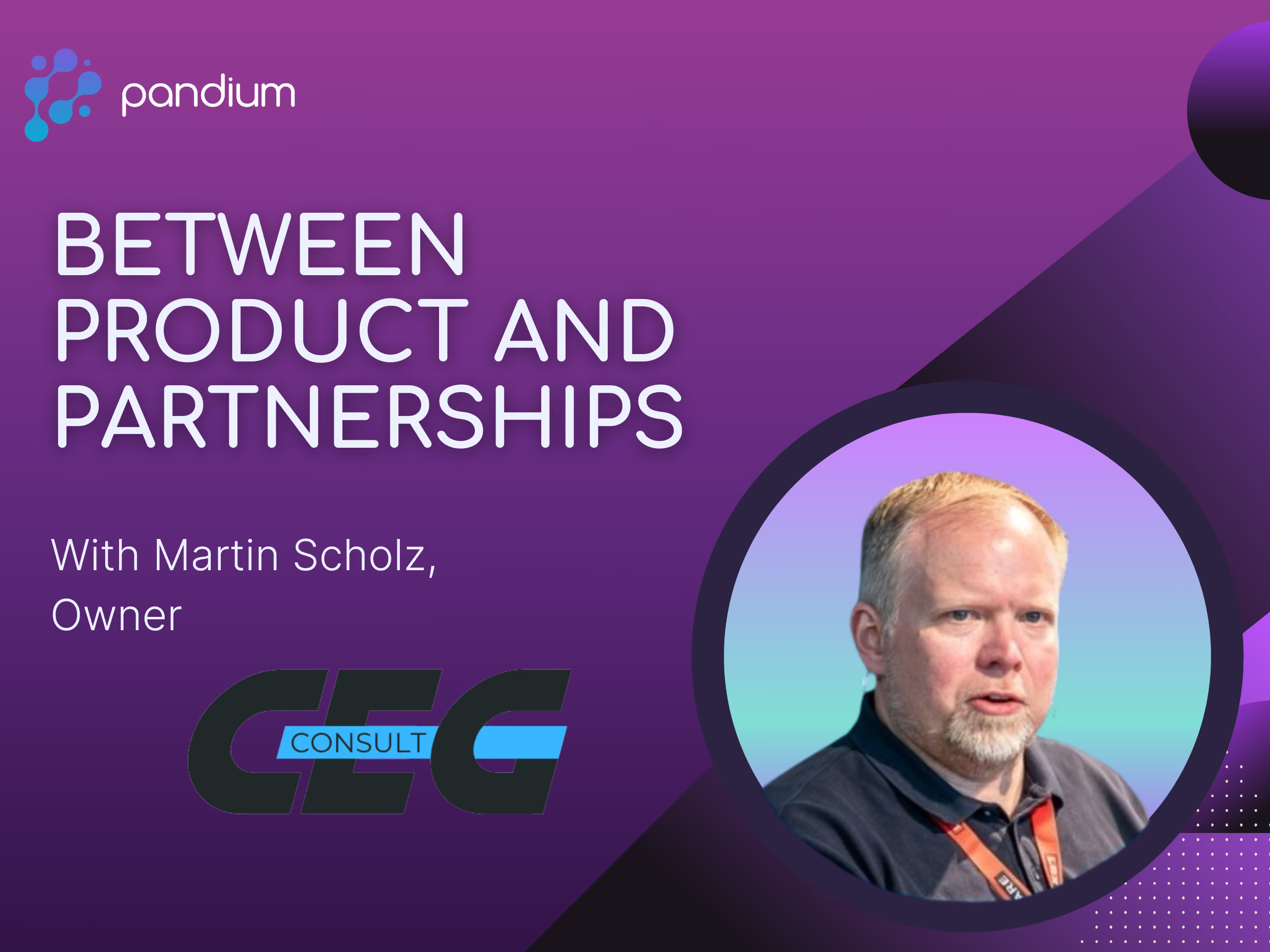
In this episode of Between Product and Partnerships, Cristina Flaschen talks with Martin Scholz, founder of CEG Consult, about why most partnership initiatives miss the mark, and what actually separates transactional deals from true, strategic relationships. Drawing on more than 20 years of partnership experience across startups, scale-ups, and enterprises, Martin cuts through the noise to explain why partnerships fail when they lack clear alignment, why "giving to get" can create toxic dynamics, and how to identify which partners actually deserve your resources.
Who we sat down with
Martin Scholz is the founder of CEG Consult, a partnership advisory firm serving B2B SaaS companies across technology integrations, channel partnerships, and reseller programs. With more than 20 years of hands-on partnership experience, including roles as an in-seat operator at three startups and advisory work across multinational enterprises, Martin has built partnerships in Germany, North America, and internationally.
Martin brings expertise in:
- Identifying real partnership value vs. vanity metrics
- Bridging gaps between product, engineering, and partnership teams
- Structuring mutually beneficial agreements and QBRs
- Building scalable partner ecosystems without sacrificing quality
- Advising companies on partnership strategy across tech integration, channel, and reseller models
Key Topics
Partnerships vs. Transactions: Why the Definition Matters
It’s easy for companies to confuse a partnership with a basic sales transaction. Martin views a true partnership as two businesses teaming up to support a shared customer, where both sides bring real value to the table. When a relationship becomes a one-way street just to hit a quota, it usually leads to friction. Real partnerships require being aligned on the overall outcome, not just agreeing to legal terms.
Integration Is Not Partnership: The Connection Between APIs and People
Just because your software connects to HubSpot, Salesforce, or Google doesn't mean you have a partnership. An integration is the technical link; a partnership is the business relationship built around it. Without co-marketing, shared goals, and actual conversations between teams, it's easy to end up as just another unread listing in a crowded app store.
The Power Imbalance Problem: Why "Strategic" Deals with Big Companies Often Stall
When a smaller startup chases a tech giant, the power dynamics are rarely equal. Just because a big platform is incredibly important to your business doesn't mean you're a priority for them. Martin notes that if a deal isn't moving your actual revenue numbers, calling it "strategic" is usually a stretch. Relying too heavily on a giant platform that treats you as one of a thousand integrations can leave a startup in a pretty vulnerable position.
The QBR as Strategic Alignment Tool, Not Status Update
Quarterly Business Reviews often lose their value when they turn into a retrospective slide deck. Instead, Martin suggests bringing leadership to the table and spending about 80% of the meeting looking ahead. The main question should be: Are we still aligned on where our businesses are going? If the partnership isn't actively helping them hit their upcoming goals, it's highly likely they will deprioritize it.
Building Reciprocal Partnerships
If you're doing 80% of the heavy lifting and only seeing 20% of the return, the relationship is out of balance. Martin advocates for aiming closer to a 51/49 split. If you can't hand over direct leads, you can trade value through co-marketing, feedback loops, or community access. If the other side consistently refuses to reciprocate, it might be time to step back.
Why CS Teams Are Your Secret Partnership Weapon
Many companies focus all their partner outreach on sales or marketing teams, but sales reps are usually hyper-focused on closing their next immediate deal. Customer Success (CS) teams, on the other hand, talk to users daily, know their exact pain points, and are naturally incentivized to find helpful solutions. Getting on the radar of a partner's CS team often leads to much more organic, highly validated customer referrals.
Investors May Drive Bad Partnership Decisions
Startups sometimes waste valuable engineering cycles building integrations with massive platforms simply because an investor wants a recognizable logo on a pitch deck. Investors are often looking for high-level market optics, but if actual customers aren't asking for the integration, you might just be burning development time for a vanity metric.
The Vanity Trap: 1,600 Integrations, Zero Strategic Understanding
Boasting about having hundreds or thousands of apps in your marketplace doesn't mean much if you don't know how many people are actually using them. Instead of focusing entirely on volume, it's much safer to track which integrations are actively growing, stalling, or being uninstalled.
MCP and AI: Why the Hype Will Die and Humans Won't Be Replaced
There’s a lot of talk right now about tech like Model Context Protocol (MCP) making integrations so easy to build that human partnerships won't matter. Martin pushes back on this, noting that ongoing maintenance costs and resource limits mean companies won't just rebuild everything from scratch. Plus, hyper-personalized AI outreach is already starting to face pushback because no one likes spam, even if it's smart spam. Relationships and genuine conversations are still where the real value lives.
Episode highlights
Tactical takeaways
- Partnerships usually require a shared customer, not just signed terms
A real partnership balances mutual goals and shared value. If it's entirely one-sided or transactional, it's likely to face friction down the road.
- Tech connections don't automatically mean business partnerships
An API integration is a technical link, but a partnership is business-driven. Without joint marketing or strategic alignment, you risk getting lost in a crowded app ecosystem.
- Avoid betting your entire GTM strategy on a single tech giant
Just because a massive platform is critical to you doesn't mean you're critical to them. It's usually safer to distribute your risk across multiple partners rather than relying on one giant to sustain you.
- Try spending 80% of your QBR looking forward, not backward
Quarterly reviews often get bogged down in past stats. Try flipping the script and focus the majority of the time on the next 3 to 12 months to ensure both businesses are still heading in the same direction.
- Look for a 51-49 value split to avoid one-sided relationships
If you are doing almost all of the giving and getting very little back, the dynamic isn't healthy. Look for reciprocity, whether that's through leads, co-marketing, or helpful product feedback.
- Consider looping in Customer Success, not just Sales
Sales reps are often too busy closing deals to focus on long-term partner plays. CS teams know exactly what users are struggling with and are well-positioned to recommend your solution naturally.
- Track active integration usage rather than ecosystem size
A massive directory of integrations can be a vanity metric. True value comes from knowing which ones are actively being used, growing, or losing traction.
- Base your integration roadmap on customer demand, not investor optics
Building a platform integration just to put a recognizable logo on an investor deck can easily backfire. Make sure real customers are actually asking for it before spending engineering resources.
Connect with the Speakers
Connect with Cristina: www.linkedin.com/in/cristina-flaschen/
Connect with Martin: www.linkedin.com/in/martinscholz1975/
Learn more about CEG Consult: www.ceg-consult.de
--
This podcast is hosted by Pandium, the only embedded integration platform that facilitates faster code-first development of integrations, allowing B2B SaaS companies to launch integrations at scale without sacrificing customization and control.
Learn more about Pandium here: https://www.pandium.com/
To access more resources and content on technology partnerships, integrations, and APIs, check out our blog and resources page below.
Blog: https://www.pandium.com/blog
Resources on Technology Partnerships, Integrations, and APIs: https://www.pandium.com/ebooks
Podcast Transcript
Cristina Flaschen (00:01)
Three and two and one. Hello everyone and thank you for listening to our podcast Between Product and Partnerships, where we talk about all of the challenges and what it takes to build partnerships, integrations and SaaS platforms. Today we are so excited to have Martin Scholz from CEG Consult join the podcast. Good morning to us, good afternoon to you Martin. Tell us a little bit about yourself and your background.
Martin, CEG (00:27)
Sure, thanks for having me. I'm excited to be here and across the pod and across the time zones. Yeah, as you can probably see on my little beard here, I'm not the youngest anymore, so I'm in partnerships for quite a long time. I always joke that I started B2B partnerships about more than 20 years ago. The first years I didn't even know they do that because back in the days that role was called business development when that was still the...
now, not the tough job of trying to make a call and book a meeting for your IE, but really developing new areas of business, which is entering new markets, whether geographically, industry-wise, or ⁓ customer segments. And very often, if you enter a new market, it's helpful if you don't do it on your own, but you have a partner who knows the market and can help you to find the good stuff. And I'm doing this. In my 20-plus years, I stumbled also then in the B2B SaaS
industry when that was also fresh, especially in Germany, which was little bit behind then. North America built partnerships, diverse partnership types, multinational, internationally for three startups as an in-seat operator. Before then, I made this jump into being an advisor, taking, so I would say my 20 years of making mistakes, trying to help companies to avoid those. We can find new ones. And that's what I'm doing today.
Trying to help B2B SaaS companies making partnerships work.
Cristina Flaschen (01:56)
Awesome. Thank you. And I have not been in partnerships officially for 20 years. I'm on the integration side for 20 years, but even just 10 years ago, I feel like partnerships as a role was really reserved for really large companies if it was technology partnerships or it was like reseller or channel or affiliate. Then there's influencer, all this other stuff. It's a really interesting role to watch. I feel like maybe right around COVID
it got this huge bump and we saw like partnership leaders and these types of groups popping up and new PRM technology and stuff. It's been interesting to see that sort of explosion of the role that I really feel like sits in an interesting spot in an org. It's like business development, also sometimes there's a technology part of it. Sometimes it's like much more marketing than sales. And you've, I'm sure seen it all over the last 20 years.
So to start off, how do you define a real valuable partnership?
Martin, CEG (02:56)
That's a very good question. I think one of the things which is challenging for us is that we do not have standing definition of what partnerships are. And you probably also came across somebody calling themselves, let's do a partnership, actually, they wanted to sell you stuff. And were sponsorships being called partnerships, even though that's pretty transactional. And I had the pleasure to do
the various kinds of partnerships. I think the common denominator for all of that is that two businesses team up to achieve a mutual goal or they have like one mutual goal which both benefit from. And very often there's a mutual customer in the middle around that. I think that's critical. That's one of the main drivers is, know, sales is transactional, partnerships is collaborative.
It changes a lot of dynamics and a lot of people don't get that, right? And look at partnerships that are transactional. You you give me this, I give you that. Ah, it's usually not the way that it works. So a true valuable partnership for me is that there is an alignment on a mutual goal and both parties win. And I don't like that too much, but it's literally this cheesy one plus one equals three thing.
Cristina Flaschen (04:18)
That is a line I have heard a lot in this space. I'm curious how in your experience,
how companies should potentially identify who that shared kind of partner is, or not partner, sorry, the shared customer is. And this comes from like, again, I work more on the technical partnership side of the house. And I think there's always an impulse if there's like a large customer to be like, that's who we need to use. I'm wondering if you, how you think about that. Cause in my experience, your largest, most like high touch, high value customer might not be the one you want to be piloting stuff with.
all the time, but just curious how you feel about it, what you've seen.
Martin, CEG (05:00)
Yeah, I absolutely know where you're coming from. This is a couple of thoughts here. Number one, the big one, huge customer is probably a big corporate, which is probably not very flexible, responsive and agile. And these are things you probably want to have if you think about what could a product integration look like. There might be too much hassle with the...
stakeholders. And at the same time, you might find yourself in a situation where they come with very specific, very custom requirements. So it might fit, they may give you a description which absolutely fits their need, but it's not repeatable, not scalable for any of your other customers. And then, basically you build an integration which is not reusable and you don't have like this ideally you want to...
like anything which should be scalable. So it should be scalable, repeatable, usable. And then you have this very, this is tailor-made for this huge big elephant, but my majority of the customer wouldn't work. So who I would probably look at is, you know, really discussing about who's your ICP. And very often this massive key account is not literally your ICP because it's like this super cool,
a brand you have, but not the one where you have 20 or 30 50 or 80 clients of. So I would look at the ICP and the common use cases they share.
Cristina Flaschen (06:30)
I agree. I do also think there's some like vibes based stuff there. Like who is your customer that is a big like user of your product, but also a champion, like a good partner to you. There'll be a lot in my experience, more like number one, excited to be working on something with you as a design partner and also like tolerant of the sort of rough edges that can come out of this stuff. But that dovetails nicely into another question about the difference between a technical
integration partner and a strategic partner. And I think sometimes those two things can get conflated and one does not need to be the other and they don't need to be both. How do you think about the differentiation between those things and like maybe when companies should look at one versus another?
Martin, CEG (07:19)
That's a very good question. I have to quote a good friend of mine, Justin Zimmerman, who was a guy who I heard from who said integrations are not partnership. Integration is a connection of APIs and partnerships is a connection of people. And I think that nails it quite a bit. So I can have wonderful technical integration with huge companies, right? I can have an integration to Google API or HubSpot or even go to the AWS marketplace or whatnot.
And that doesn't make me necessarily a partner. Even they probably call you this way. Basically what you do is you pull a number and you're startup 1,715 who's in the line of being integrated or connected to the APIs. And that doesn't mean that anybody at Google gives a about you and what you are doing. So.
The partnership layer would be then that you literally manage having a business-driven conversation. I'm literally, I just yesterday, I visited one of my clients where we had this journey where they had a marketplace of 200 something integrations, which are critical for their core product to function. And it does really increase the value of the thing. They were focused on the technical quality of these integrations. Then I said, why don't you have partnerships with them? Why don't you have a meaningful business conversation?
with them, how to market that integration and the value you create for them. Last but not least, strategic. I dislike this term a lot because it's used internationally. ⁓ it's a strategic partnership, which is for me, this is a quality criteria. I would reserve this I did reserve this in my history for, or does reserve that for partnerships which are so critical for your business success that you do see it in your P&L.
In your revenue or a top line or a bottom line result, whether or not you would have this. So that's, and whether or not this other partner is large or small is not necessarily relevant. It's just like how big is the impact to your own business. What a lot of people call strategic partnership is they as a small startup, try to partner with one of the big guns and then they call it strategic. Guess what? They, this partnership might be strategic for you, but most likely you're not strategic for them.
So it's a very unbalanced partnership.
Cristina Flaschen (09:39)
Yeah, I've spoken on this podcast a lot about the dangers as a small company of like hitching your wagon to one big partner, strategic partner. And, you know, on the strategic partner side, you could have a partner manager that is giving you a ton of attention, but that's their job. Right. And they're doing that for hundreds of partners potentially. And I've just seen so many folks like, you know, really put a lot of time and energy, like years worth of time and energy into that relationship. And.
It doesn't work out for one reason or another through nobody's fault. It's just like the momentum dies. And that is like that line on your P and L if it's like a hundred percent of something, it's very scary tied to one external company. You know, companies have made entire businesses around that, but I think it's, it's a dangerous, it can be a dangerous game.
Martin, CEG (10:30)
It's a bet, right? If you place everything on one number in roulette, then you may win or may lose everything, right? If you distribute it, you have more chances to succeed. But I totally hear you. I mean, one of the things is what I always try to teach my clients is, you know, it's nice that you have the relation with the partner manager, but this person, she or he is usually not the person which will execute the partnership. They are the persons who own the relation.
If you want to have a technical integration, need to get through the product team. If you want to promote this integration, you need to get through to the marketing folks or to the sales folks or the CS folks who can actually talk. You look at, hopefully this integration will also generate some needs at one day. The parliaments will not give you leads because this person is not customer facing. And that's where this whole very often dies.
Cristina Flaschen (11:19)
Yeah. So there's a question. Like if you're working with your partner manager, you're working with a partner manager at a really large company and you want to do that multi-pronged approach that you just described, like sales, marketing, product, maybe engineering, like who knows customer support. How do you do that? Like what's a way to, and I think caveat, I'm not expecting like a handbook because I think it's very different in every org, but like, have you seen folks do to be successful in getting kind of those inroads into all these
different teams.
Martin, CEG (11:51)
It depends a bit on the size of your own company and your own role. What I would or did with my teams in the past was whenever I had people like who helped me and became like the partner managers on my team, I'd always challenge them, ask them and force them to, know, if they do QBRs, whether that's quarterly business reviews or...
same quality, whatever. But I said, look, the QBR is not you and your partner manager. This are the monthly, the weeklies. The QBR needs to have the strategic alignment component in there. So you need to make sure that you bring at least your plus one, like me, or maybe even our next level, like the founder or C level. Especially if you're a smaller startup, you probably need to bring in your founder to get attention on the other side. But then also require from the other side, that's not just no disrespect to the person, but not just the partner manager
but her or his boss, or maybe as high up in the hierarchy as you can responsibly ask them to bring into the QBR. And for me, the QBR is not about reviewing the last three months. Like, you know, it's maybe 15%, 20% reviewing what he did in the past, but 80% should like, what are we doing the next three, six, nine, 12 months? And it should always start as, we still strategically aligned?
Is this partnership still paying into your business goals to your partner? Because if the partnership with us is not paying into their business goals directly, they will not prioritize it. We can have all the wine and dine and we can all have the nice chitchats and we can all have this wonderful relation. But ultimately, if we don't contribute with our partnership into their goals, we will not be relevant for them.
Cristina Flaschen (13:38)
Yeah, I a hundred percent agree. And I think the way that I've tried to approach this in my own career is always with like a give. Like, you know, I think if you can get some people on the QBR, that's incredible. Like do it, but also like marketing as an example, like marketing teams, everyone's trying to make content all the time, do events, whatever. And to your point, I don't think like a dinner is enough, but to be like, Hey, like we'd love to write a blog post for you. Like, what can we, like, what can we as a company do to help you human
individual, is sometimes an easier task than like, let's meet. Like someone's like, I don't want to meet with you. Why do want to meet with you? But it's like, Hey, I have an idea of a thing that I'm going to give to you that you can then use to make yourself look better. That always helps. I, my own personal, like soft spot is always for customer support. I feel like they.
CX teams like really no boots on the ground, like what's actually happening. And I'm always trying to like get our team to like align the CX people at our customers if they are the ones that are supporting integrations. Like, Hey, you know, the product manager, the head of product might say everything's great,
but the real rumblings under the hood or that like, ⁓ you know, this thing wasn't working or it doesn't do what we need, whatever it is. Like, and those folks, think oftentimes, and I hope this changes, but I always get a sense that CS is sort of like overlooked.
It's like their job to get yelled at. Like, it's like, who cares? But I, you know, I feel like they don't get a lot of attention. So when, when you can be like, Hey, I actually care about like your experience and your customer's experience, like how can we work together to make things better for you? That always is helpful and can give a lot of, a lot of strategic insight that you might not get from like a biz dev person, you know.
Martin, CEG (15:04)
Yep, yep, yep.
Absolutely. No,
couldn't agree more. I want to double down on two things you said, like number one, I always, you know, also recommend try not to, don't try to connect with the salespeople of the other company because, you know, they have a very narrow focus and everything you do ask them is distraction. So they are less likely to, usually less likely to, to responsive, especially in the beginning. So I always.
point the people to the CS team just for the same reasons you said. They know they have much more deeper relation with the customers. Much more regularly hear the pains and the wishes and the challenges they are facing. They are much more positioned to even mention the integration. Like, if this is a problem, do you even know that we have this other partner who could help you fix this? Because no sales rep will do that unless it will help them to close the deal.
In the first place. So a hundred percent aligned here, where I'm not a hundred percent aligned is this give thing. I think that's a bit toxic. You know, when I hear this from cast of partner folks, they, we have the saying, right? It's you have to give to get, you have to give to get. And I was like, yeah. And I use that phrase a lot myself. And then I was like, wait, why? If we agree that it's a collaborative relationship, you know, both should be.
As hopefully equally committed and interested in this partnership, actually, you would need to want to give me first, while I would try to give you first. It's like me and you and being in a restaurant and I say, picked the bill the and you say, no, I picked the bill. This kind of thing. So this dynamic should happen. So what I see a lot of companies struggling with partnerships, they say, we need to give first. We can't expect getting anything. We need to give them something. And then they end up giving, giving, giving. And then you have something which is like,
80-20, right? And then, you know, if you give 80% to get 20% back, you know what? You're in toxic relation. And what you do in a toxic relation, you walk away from it because it's toxic. And I can't remember the name, but there was a very experienced partnership leader. She said, like, VPSP partnerships, some years ago in the training, she said, 51-49. 51-49 is enough. If you give 51 to get 49 back, if it's 80-20, walk away.
So while I feel like this is a very natural motion for us partnership folks to think we need to give first, I would challenge everybody to think, is it really needed? And if you give, how much do you give to before you really expect getting something back?
Cristina Flaschen (18:03)
Totally fair. And I agree with you. I think it's a good point of clarification. In my mind, what I think about, hey, we're gonna write a blog post for your blog. What you as a company get out of that is a giant audience, hopefully, from being on the HubSpot blog or whatever it is. I agree with you. definitely seen, I think it goes back to that like...
being the little fish in a strategic relationship. Like if you're just constantly chasing and like investing a ton of money and having a ton of meetings and like flying out and like all this stuff and there's no reciprocity like that, that can feel like, it can feel like strategic momentum when it's not, right? If you're not getting any skin in the game back from that. And I think there is like a natural power dynamic in almost every partnership that there is a larger company and they might not even be like,
more employees, but they have something that the other company wants, which is typically like a large customer base or access to data or something like that in a technology partnership. And it can be easy to your point to like be the 80% and not be on the receiving end of that.
I do think it's an interesting thing and I don't know if in your background you've experienced this when you have two large companies that are trying to like build these relationships. We work with some really large companies and like it's always fun to watch. Like if you've got two big fish, like who's going to do the thing? Like who's going to cave? Like who's going to, you know, in our world it's like who's going to build the integration, who's going to support it, who's going to pay for it? And like no one wants to do it.
Martin, CEG (19:31)
motivation.
Mm.
Cristina Flaschen (19:36)
Some eventually somebody just says we just need to get like it's been three years. We just need to do it and like bite the bullet. But I don't actually have a good rubric for that when it's like two publicly traded companies that are massive and they like they know their strategic value, but like nobody wants to make the commitment. I don't know if you have a war story around that. I see it all the time.
Martin, CEG (19:55)
For me, was always when I
came into, I mean, I never worked for these huge companies, but when I was in similar situation was basically scaling it down to when the other company was about the same size. It was not the clear bigger fish. And basically both said, we agree it would be great to have that.
Cristina Flaschen (20:10)
Yeah, yeah.
Martin, CEG (20:17)
And then everybody went, know, in the earlier days, was a question like who has an API and who's not. then the other one had to develop against the other one's API. then most times, very evolving APIs became more standard. had service based architecture or service under architecture. So everybody could make things stuff available on APIs. So it wasn't like, well, we have an API you can develop again. Well, we have also an API you can also run. And I was like, okay. And the thing at one point, which we solved it was like, well, you know.
Cristina Flaschen (20:21)
Mm-hmm.
Yeah, yeah, yeah.
Martin, CEG (20:47)
One develops, the other pays 50% non-recurring engineering cost. So basically splitting the bill. That was then the pragmatic one. You know, because it was also, you know, a resource constraint. And at one point we even said, look, if you don't want to develop it and we can't, well, don't want, it's like, you don't have the capacity on your engineering team or on the roadmap to develop it and we don't have it.
Well, then we both put 5K in and we hire an external developer who's literally developing this for us and we share the IP on it. And that was literally a solution we did not only once where we had this kind of, it wasn't even that nobody wanted, was literally the resource constraints on both ends.
Cristina Flaschen (21:32)
Mm-hmm.
Yeah, we've seen folks be successful with that too, where it's like, we're going to split the bill or, you know, this company is going to build it, but then this company is going to pay like a higher rev share. Or like, there's all kinds of ways to do it. I think it is when it's like two smaller companies and by smaller, mean, like not publicly traded, not massive, right? Like there's it, there's like a human element to your point where it's like, all right, like, how can we figure this out? The big giant ones. It's always fun when you see like an Oracle and an SAP. I'm like, yeah, yeah, yeah. It's just, it's, know, and like,
Martin, CEG (21:59)
Yeah, we have a political company, yeah.
Cristina Flaschen (22:04)
from here at Pandium, selfishly we're looking at the tech side and I'm always like, this is not a technical problem. The APIs to your point, the APIs exist these days, there's ways to do this. It's like, what do you guys want to do as a true partner and hopefully a long-term relationship? Because once those connections are made, especially if you're an enterprise product and your customers stick with you for five plus years, you're really in bed with them at that point with this other company. So it's like, you're going to be
Martin, CEG (22:31)
Absolutely.
Cristina Flaschen (22:33)
want to be a good partner, but also kind of play this dance. At the end of the day, the building of the integration is usually such a small part of this whole bigger exercise.
Martin, CEG (22:49)
Agreed.
Cristina Flaschen (22:50)
So let's maybe we've talked about the power dynamics a little bit. Since you've been around the block, folks that listen to this love to hear again, sort of like the battle stories of what you've seen. So what do you think are the most common failure patterns that you see companies make when they are building their partnership program or trying to recruit new partners?
What advice would you give and what do you see folks do poorly consistently?
Martin, CEG (23:24)
I mean, focusing on that. So I have to make this disclaimer, I'm working on both sides on technology integration partnerships, as well as the, which basically core channel, which is, know, reseller referral and all that stuff. But one thing which is always the same is that people start partners or the order to start partnerships from the leadership team or someone from the leadership, either one that comes from only like a small part of the leadership team. So.
Somebody says, let's do this, but it's not aligned with the other teams. And then you kind of work in a silo and actually the company is not even aware. And the one thing about partnerships is always touches all teams sooner or later. The second thing is even if it comes from a broader leadership, the why do we do this is totally unclear. On integration, sometimes it's
yeah, let's do this. And I've been in places like in 2020, when was it? 2024? I think I was in San Francisco to a conference, cloud software association, very much around technology integration partnerships. And I was like, oh, amazing. And then it was about the time when Silicon Valley bank went south. So a lot of partnership people at that point lost their jobs, literally, but specifically also in these tech partnership space. And I spoke with some there and it's like...
Well, you know, I can't even imagine the use case. Why did you even build this? I mean, why did you as a startup even integrate into Salesforce or Adobe or what not? What is the use case? And they were like, oh, there's no one. I said, why did you build it if there's not a use case behind it? And then I was like, because the investor wanted it. It was like a brand, a logo on the investor's slide deck. Like, you know, we integrated with ABC. I was like, you...
have learned the hard way that investors are not always the smartest people on the block. And I don't know disrespect. I mean, they are smart in some areas, but too often they doesn't seem to even bother to understand what the product is actually about. They just look at their KPIs, CLTV to CAC ratio, CAC payback period, ARR compound gross, and then they just invest, but they do not understand the product.
Cristina Flaschen (25:33)
Payback period.
Martin, CEG (25:44)
And then I say, why don't we integrate with Salesforce? I saw these other guys have integrated with Salesforce. Shouldn't we also? And then the bot goes like, the founders go like, OK. So that was kind of this stuff which I saw and which I think it's crazy that this is built. I also have been on the other side. ⁓ When I was meeting on this conference, a direct senior director
are responsible for a more of a public list company. And he was like, oh, we have 1,650 apps in our app store or integration in our app store. And I was like, okay, how many of them are active? How many are actually used? And that was just a vanity number, right? I mean, he could brag about this and it looked good on their marketing side, but I want to like how many of these 1,600, probably 1,400 have been wasting their time, effort and hopes on it. And I don't know if they...
expectation setting when these people, these 1400 companies decided to build this integration, that was even clear. And maybe a lot of them hope that they get business out of that. And I think they will be terribly disappointed.
Cristina Flaschen (26:57)
Yeah. And it's wild to me also to your, your first anecdote there about like building the Salesforce integration, like going into that blind is so much work. Like, like building into these like larger companies is oftentimes like not a single thread type thing. Like there's, know, they have rigorous requirements for approval and like, you should definitely do it if there's a need, but like, that just feels like such a huge amount of work for like, not any value. And to your point about the, you know, 1600 apps.
I wonder if that person even knows how many of those are being used. Like a lot of times when these larger companies started companies that are larger now, you know, when they started these app ecosystems 10 years ago or whatever, they didn't instrument around like tracking or visibility into any installs even. Like, sure, maybe you have an OAuth 2 apps, you hypothetically could figure out who's using it, but like a lot of these larger companies have to do some very crazy
database work to figure out like is that app even being used by anybody today on their own side and like that is obviously a huge miss like I would be curious. Some companies have done a great job of like keeping up with it. But again like the integration stuff so often from the tech perspective is like the cast-off It's like yeah, just build to our API and then all of a sudden you've got a thousand companies doing that and it's like ⁓ Who's actually using it and why like what's happening or somebody is you know beating the heck out of your API for some reason you're like
Who is it? I have no idea. ⁓
Martin, CEG (28:28)
Yeah, that's crazy.
that? I mean, but that's, think comes back to the one thing I said in the beginning that partnerships are often understood or measured like, because the partnership falls report into people who have more sales background. So they look at partnerships on a transactional one on sales, know, close deal or signed deal is the best one. But then in partnership, they say probably there the person has been measured on not active or used integration, just on sheer number of integration.
So the more the merrier, right? Instead of making sure that these things are actually working or are meaningful and used by the clients. Even with one of my clients I'm working with, who also had this kind of things. I said, well, do we have transparency on which apps or integrations are actually used? And so they didn't.
And we started to try to dig deeper into it. And the good news is by now they have it because they understood why they should care for it. And now there is even a core of their data warehouse. So they can actually monitor which apps are growing, shrinking, are actively used, are tested and de-installed because there's a lot of, as you say, there's so much value in understanding.
What is used by your customers? is valued by your customers? Now with this, and I know that's also a topic you've been vocal about with AI stuff coming up, there might be some of these, especially like add-on apps, which might have been a great value in the past three years.
They might just be dying because they are literally replaced by some agentic AI coming up. And I'm not a big fan of it, but there are use cases where agentic AI can easily replace what used to be a nice plugin.
Cristina Flaschen (30:27)
100%, especially when it's like these kind of discrete workflow related things. Like there's a ton of opportunity there for, you know, applications that are really features to be turned into something agentic potentially. I think we're coming up on time. I could talk to you forever, but with that in mind, maybe in parting in this year of our Lord 2026 with the AI and the MCP and all the things, do you have any piece of advice for partner managers out there for?
the rest of this year and looking into next year.
Martin, CEG (31:01)
Wow, where's my crystal globe? I would say, I think I would absolutely double down what you said in the beginning as intro that partnerships have been growing and becoming more relevant and are keeping becoming more relevant. I think I personally believe there's a huge hype around, especially on the tech side of things about MCP and all that stuff. I think people do underestimate the
Cristina Flaschen (31:04)
Yeah, tell us what the feature, come on.
Martin, CEG (31:31)
the requirement of maintenance. And in my bubble, people say, if you just wipe code stuff, or I canceled this, I built my own stuff, and I just connected this, and blah, blah. And that's all nice and fine when you are like me, a solopreneur, and you do it for yourself. But assuming that even midsize companies would invest there,
Cristina Flaschen (31:56)
Hahaha!
Martin, CEG (31:57)
limited resources in rebuilding stuff, which is even if they could do it, I mean, you know, then they don't have the time to run it and maintain it and so on and so on. So I guess my long words mean don't panic about MCP, killing your jobs or what not. I think there is there's a way where we as software companies can develop more efficiently, but that doesn't mean that, you know,
everyone will become their own software developing solutions. Don't panic. It's just a hype. It will die. It's already dying in my opinion on a couple of things. I'm not so deep into it on the tech side because I'm not a developer, but on the product sales marketing side, see AI re-outreach is dying because nobody wants to get hyper personalized spam. I know, arguments that there was this time when everybody came that
job interviews will be done by avatars, or SDR jobs will be done by avatars. Come on, if you don't take the time to talk to me when I apply for a job as a company, why would I care for your company if you don't even care for me? Same goes to outreach. I guess the best proof is if you see this, the job ads for Anthropic for SDRs and SDR leadership. Apparently, the company is building that AI doesn't trust the AI to replace these jobs.
Yeah, guess that's my very long answer.
Cristina Flaschen (33:22)
I feel like you and I could have a whole conversation about this. And you and I are, we're old enough to remember when we were migrating everyone from homemade custom software to SaaS. We've seen this movie before when it was coming from on-prem stuff that everyone had built. And there's still a ton of it, right? But like,
Martin, CEG (33:24)
Anytime.
Cristina Flaschen (33:44)
there's a reason that the entire software and technology industry got away from all the homegrown stuff that's really specific to you. And now we're like going back into that cycle. It took 20 years, but it'll be interesting to continue to watch. I agree with everything you said. Cool. I think we are at time. This has been so fun.
Martin, CEG (33:57)
Absolutely.
Cristina Flaschen (34:02)
When you make it to New York, you have to let me know so that we can meet in person. I don't think I'm going to be out your way anytime soon, but if I am, definitely will let you know. We really appreciate you taking the time to hang out with us. We'll drop your LinkedIn when we, when we post this and to our listeners, if you guys are interested in more content, even more content about API's integrations, partnerships, building SaaS platforms, security, some AI stuff, some spicy stuff. Check out our website, pandium.com. We've got blogs, we've got eBooks, we've got all
things. We have all these all these episodes. And yeah, Martin, it's been absolutely great. I hope you enjoy the rest of your evening and I'm sure we will see you out there.
Martin, CEG (34:42)
I'm looking forward to it. Thanks for having me. Have a great day ahead of you.
Cristina Flaschen (34:45)
Thanks. And I'll cut it.
.avif)