Why Partnerships Fail (and How to Fix Them): Insights from Jenn Steele, SoundGTM
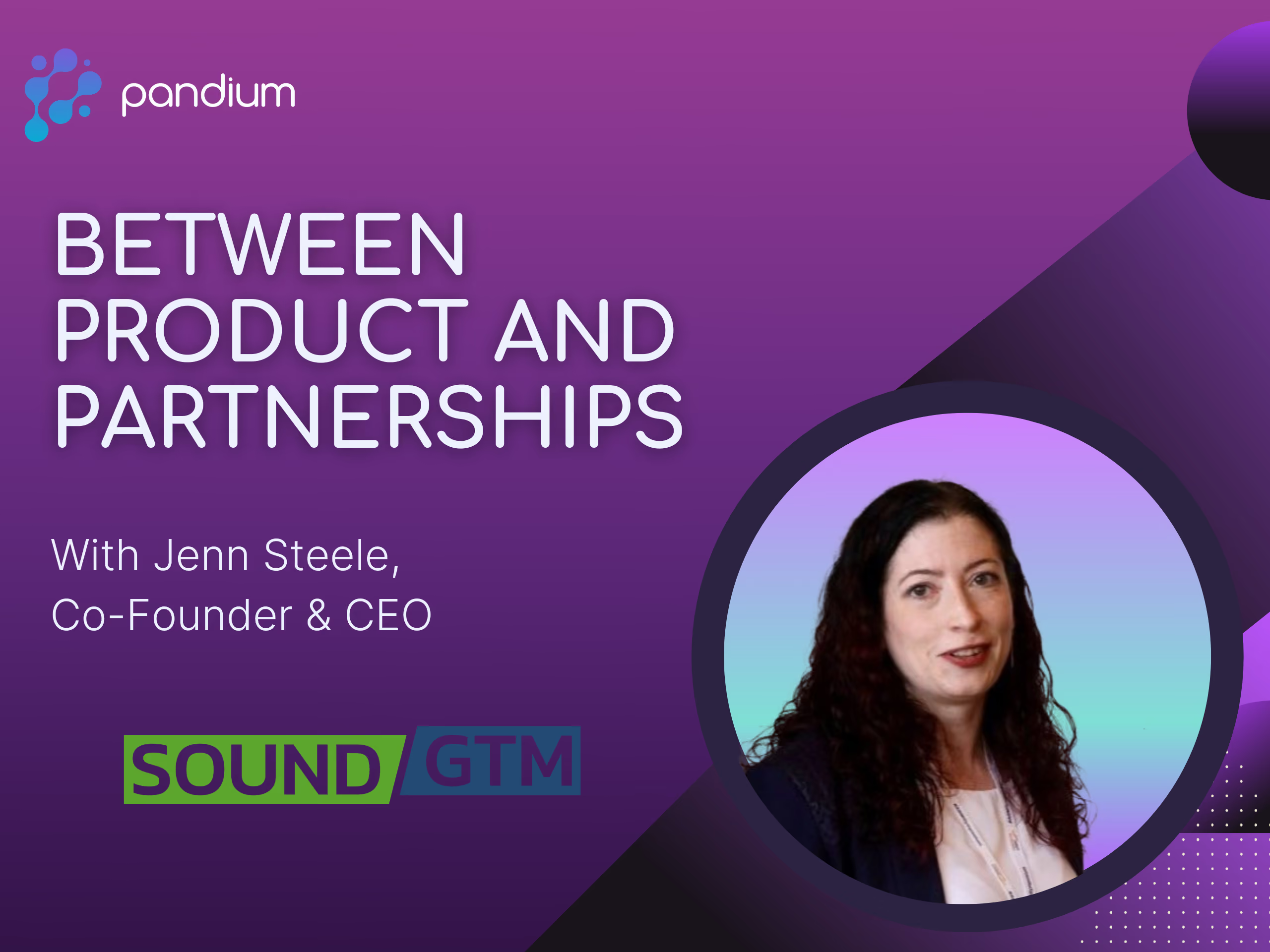
In this episode of Between Product and Partnerships, Cristina Flaschen sits down with Jenn Steele, CEO of SoundGTM, to pull back the curtain on why most SaaS partnerships collapse.
Jenn draws on her experience as a former CMO to explain the internal perspective of leaders asked to support partnership launches without proper lead time. The conversation dives into the common pitfalls of "pre-launching" integrations that aren't ready. It also covers the dangers of concentration risk with large platform partners as traditional outbound sales models struggle.
Throughout the episode, Jenn emphasizes a consistent theme: Partnerships are built on human relationships, but they survive on operational clarity and consistent enablement.
Who we sat down with
Jenn Steele is the CEO and Co-Founder of SoundGTM, a platform designed to help partnership teams drive revenue and reduce failure rates. A former CMO and "turnaround CEO," her career includes leadership roles at HubSpot and Amazon.
Jenn brings expertise in:
- Bridging the gap between marketing and partnership functions
- Diagnosing the operational failures that lead to high partnership churn
- Scaling go-to-market strategies for Martech companies
- Navigating the complexities of technical dependencies in integration-led partnerships
Key topics
The Resource Gap: Why Marketing and Partners Clash
Partnership teams often operate in a silo and call on marketing for last-minute press releases without providing dedicated budget. Jenn explains why this misalignment leads to internal frustration.
The Disconnect Between Revenue Goals and Budget
Many companies expect a significant percentage of their pipeline to come from partnerships without allocating a corresponding percentage of their go-to-market budget. Jenn warns against expecting outsized gains from minimal resource investment.
The 80/20 Rule of Partner Portfolios
Most partner programs are top-heavy. Jenn discusses how to audit a portfolio to find the 20% of partners producing value while moving on from the rest.
Operationalizing the "Shiny Object"
Partnership leaders are often "people people" who are great at starting relationships but may struggle with the administrative details of ops. Jenn highlights the need for systems that keep partners engaged long after the initial announcement.
Concentration Risk and "Big Guy" Partnerships
Hitching a small startup’s wagon to a giant like Salesforce or HubSpot is a high-stakes game. Jenn explains why being at the mercy of a larger partner’s API can leave a small company vulnerable to sudden changes.
Episode highlights
00:40 — Jenn’s journey from "Early HubSpot" to CEO
2:19 — The friction between marketing leaders and partner teams
04:02 — Where should partnerships live? (Sales vs. Marketing)
06:35 — The reality of technical dependencies and API downtime
08:40 — The cautionary tale of the two-year "pre-launched" integration
12:15 — Primary failure modes including goals and internal resources
16:23 — Why everyone is focused on partnerships right now
18:36 — Managing expectations for partner-sourced revenue
22:31 — How to keep partners excited through consistent enablement
28:40 — The danger of concentration risk for small companies
Key takeaways
1. Move partnerships to Revenue (Sales)
Because most partnership agreements are designed to drive pipeline, their day-to-day accountability should sit with the sales org. This ensures they are measured against concrete business outcomes.
2. Never pre-launch a technical integration
The "unknown unknowns" of a partner's API can turn a 6-week build into a 2-year project. Marketing a logo before the data structures are validated is a recipe for brand damage.
3. Enablement is the cure for fading momentum
Partnerships often fail because the initial excitement disappears. Success requires a repeatable cadence of webinars and co-marketing to stay top-of-mind.
4. Audit your portfolio ruthlessly
Not all partners are created equal. Identify the 20% that drive value and focus your limited resources there.
5. Relationships are the foundation, but Ops is the frame
Being "good with people" gets the deal signed, but having the operational infrastructure is what makes the partnership scale. This includes clear SLAs and data mapping.
6. Look for "Mutual Backscratching"
If you can’t provide leads to a partner, you must provide something else of value such as rev-share. A lopsided partnership will eventually lose internal support.
Connect with the Speakers
Connect with Cristina: www.linkedin.com/in/cristina-flaschen/
Connect with Jenn: www.linkedin.com/in/jenn-steele/
Learn more about Sound GTM: soundgtm.com
--
This podcast is hosted by Pandium, the only embedded integration platform that facilitates faster code-first development of integrations, allowing B2B SaaS companies to launch integrations at scale without sacrificing customization and control.
Learn more about Pandium here: https://www.pandium.com/
To access more resources and content on technology partnerships, integrations, and APIs, check out our blog and resources page below.
Blog: https://www.pandium.com/blog
Resources on Technology Partnerships, Integrations, and APIs: https://www.pandium.com/ebooks
Podcast Transcript
Sarah Elkins (00:00)
Welcome to Between Product and Partnerships, a podcast focused on bringing together product, partnership, and engineering leaders to discuss how to build, support, and scale SaaS ecosystems. This podcast is presented by Pandium, an integration platform for building native integrations.
Cristina Flaschen (00:19)
Hi, everyone. And thanks for listening to our podcast, Between Product and Partnerships, where we talk about the challenges and what it takes to build integrations, partnerships, and SaaS platforms. My name is Christina, and I'm the CEO here at Pandium. And today, we are so excited to have Jen Steele, CEO of Sound GTM, join the podcast. Do want to share a little bit about your background, Jen?
Jenn Steele (00:40)
Sure, sure. So what a strange road brings you to CEO and co-founder. I assume you have had a similar journey, but ⁓ I'm a former CMO. I think it will just truncated at that. was early HubSpot. was at Amazon, blah, blah, blah, blah. ⁓ But I was a former CMO. And after I became a turnaround CEO at Kismetrix, I'm a big Martech person and...
I ended up my board chair there after I sold it was like, do you want to take this platform to market? It's affiliates. And I'm like, no, affiliates is gross. I really don't want to deal with any of that. But there were a few things that happened. One is that I have a lifelong obsession with things that I have failed at and I want to make them better. And I like hard problems. So.
What ended up happening is I realized, hey, I can take this platform. And after an aborted attempt pivoted to focusing entirely on partnerships in part because 50 to 80 % of them fail. And when I was a chief marketing officer, I helped some of them not do super well. And so for me, the question is.
What makes, especially at companies that like don't have an 80 person partnership organization, what makes them fail and can I help fix it? Like I, my mission is to drive that failure number down in part because I used to drive it up.
Cristina Flaschen (02:09)
That leads well into, I think, the next question, which is when you look back at your previous roles as a CMO, how did you work with or maybe not work with partner teams?
Jenn Steele (02:19)
I still so I'm still friends with nearly every partnership team person I have worked with in the past, probably because they're very friendly and forgiving people not because I deserved any of that. But ⁓ so the primary way I worked with a partner team.
was to be exasperated that I would get called in for a press release last minute, or suddenly I'd have to do a webinar and I did not have the resources. And yes, partner marketing was under my purview. And I came from product marketing, which is like right next door to it. However, I didn't have the resources partner, even when I was VP of product and marketing that included partnerships. Partner marketing was one out of 10 things I was doing.
Like I literally had 10 different areas of responsibility. And so for me, it was just like, oh, why do I have to do this? And then working with a partner on a press release is really painful and what's going on now? And so of course I would make them less likely to ask me things because I was whiny. So, so not well.
Cristina Flaschen (03:27)
I bet they wouldn't say whiny, but it sounded like you, ⁓ you had a lot in your plate and you were working at some pretty large orgs. So that makes sense that this was not like front and center. Yeah. Of course.
Jenn Steele (03:35)
Yeah, depending on the org, you never have enough resources, right? I mean, I
did not have a dedicated partner marketer on my team. And so that's part of the person I'm trying to get is that person who has the winey CMO, who doesn't have dedicated ops, who doesn't have dedicated partner marketing.
Cristina Flaschen (03:53)
And in those situations, did the partnerships teams roll into like, I guess it sounds like maybe they rolled into you, but you didn't have a marketing person? Was that the structure typically? Okay.
Jenn Steele (04:02)
So they didn't roll into me. One,
the thing is, it's so funny because they, roll in at lots of different places. And I think I've experienced that at one point, somebody asked if they should roll into me and I was like, well, they can, but I think they should roll into sales because
Cristina Flaschen (04:10)
I know.
Jenn Steele (04:22)
most partnership agreements, you're trying to get more revenue. Therefore, let's have them go into revenue. their processes are, yes, there's partner marketing and it is its own thing and it is the marketing cadence, but their day-to-day accountability really should be pipeline and ideally closed deals. And that's not necessarily marketing. That is sales. But I have worked with partner leaders that have reported to the COO, to the VP of demand.
Cristina Flaschen (04:38)
Mm-hmm.
Jenn Steele (04:51)
to sales to basically you name it.
Cristina Flaschen (04:53)
Yeah.
I feel like it also can kind of depend on what kind of partnerships you're talking about. Like if it's like reseller, like that is like a straight like operations and sales thing versus technology partnerships, which may have like a product element versus affiliate. it's, so that word like partnership is huge.
Jenn Steele (05:11)
Or like if you only did integration
partnerships, then maybe it's CS because it's or implementation partnerships. Like, and I always mix up the ISV terminology and things like that because it's hilarious, but whichever one means we sell, you implement, maybe it's CS, you know, it just depends.
Cristina Flaschen (05:27)
Mm-hmm.
Yeah, it's interesting to see in our customer base too, like seeing where those teams sit and then how they move around. Like some of our customers we've been with for years and years and like the people that run those teams have been rolling into different groups, including like being sort of that foundation of like a strategy group or a platform group. It's sort of all over the place without one clear home, think in a lot of orgs, yeah.
Jenn Steele (05:52)
Interesting. It's
like, how do we make them perform? How do we make them not annoy me when they ask me questions that nobody else asks me? Because, well, it's true. It's true because it's like in a normal sales led organization, you have two parties. We're selling the thing and you're buying a thing. When you start getting partnerships involved, now you have a third party and almost none of your thought processes or processes are designed for it.
Cristina Flaschen (06:12)
Yeah.
Yeah, hundred percent. And we talk a lot on the podcast and generally out in the world about like dependencies and how integration work and partnerships that have integrations. Also just commercial agreements, but integration, especially there's like lot of hard dependencies and assumptions, assumptions you have to make that live like outside of the four walls of your business. And you may or may not have the ability to influence that other company and you may or may not be able to get them to do things for you from a technical perspective. So it's definitely.
Jenn Steele (06:35)
Right.
Mm-hmm.
Cristina Flaschen (06:49)
I think different to your point from straight sales, straight marketing, and definitely different from straight product engineering of greenfield ⁓ features.
Jenn Steele (06:55)
Yeah,
yeah. And you're interdependent. mean, yes, marketing is always dependent on product and sales. And, you know, it's like the three corners of the stool, especially in tech companies. ⁓ But it's just like, can I send out this press release? no, we're having a problem with our API. Suddenly, it's like, at least if it's my own product, I know the launch schedule. Like, I know, like I have a little more control.
Cristina Flaschen (07:18)
Thanks.
Yeah, yeah, That reminds me of like, I feel like I've been on live demos so many times demoing an integration at like XYZ place. And yeah, it's like the partner API is down. It's like you're sort of just host at that point, but it doesn't make doesn't make anybody look good when those things happen. Of course.
Jenn Steele (07:36)
I
I did a webinar where I was demoing, like we have an agent that ⁓ creates a joint ICP and then pushes that into your HubSpot. So you can see which companies you have already in there that actually would be great for co-selling. And the morning of the webinar where I was launching that, cause I was launching it in partnership, they changed their primary, like their API was fine, but
it wouldn't open the page because they changed the page URL. And I'm like, thank you so much HubSpot. Thank you.
Cristina Flaschen (08:06)
Yes,
yes, yes. These are the glorious things that I feel like you and I maybe should do a crash course about how to do a live demo, how to mock live demos. I feel like I've seen too many that have gone off the rails. And I'm like, I know how you mock that. So you make it look like it works all the time. ⁓ So you mentioned about the press release with an integration not being built yet. And that is a thing that I have experienced as the person who's responsible for the builds.
Jenn Steele (08:23)
yeah.
Cristina Flaschen (08:33)
learning that an organization has announced that this thing is ready to go and being sold. I'm like, news to me, we have six more weeks left or three more weeks left or whatever. Curious if you could just share that anecdote. Some folks here might get a kick.
Jenn Steele (08:40)
Mm-hmm.
Yeah, so there was a company once upon a time there was a company that I joined that has since gone through a couple of acquisitions. So they're no longer known by the company name. So I'll just leave that nameless. Before I started at the company, they announced a key integration with a large partner. ⁓ I was at the company, unfortunately, there was an acquisition or fortunately, and somebody else came after me for a better job. And so I did all of that.
But so I left the company about nine months later, still wasn't done a year later. It still wasn't done because it's like, the partner keeps changing their API, et cetera. mean, I was getting to the point that I was just like popping the popcorn and watching because all in all, was about two years.
I will never, ever pre-launch an integration, especially with like, you know, I'm the little guy and it's the big guy because you are at their mercy. Like when they changed their API, we were just dead in the water.
Cristina Flaschen (09:48)
Yeah, well, it's also like the unknown unknowns. What is it like the 80-20 rule around like the last 20 % takes 80 % of the time. And it's also like most of the value. I feel like that is very acute in this space. Like getting something that is like sort of functional enough to say that it's dev done is typically not that long. But then that extra like 10 to 15 % in my experience is like the hardest part. And again, it comes into like dependencies. There's like so much going out on
Jenn Steele (10:13)
Right.
Cristina Flaschen (10:18)
not even just from a technical perspective, but like you're trying to learn this additional system also to figure out like how to make the thing work. there isn't, I mean, people hate me because I say this, but like there isn't actually a shortcut for that. Like you just have to learn how it works if you want to build something that's going to be good for your customers.
Jenn Steele (10:22)
Right.
Right.
Yeah.
I mean, fundamentally, so many integrations come down to data structures and everybody sets all that stuff up differently. And it's like, what do you call this field? What do we call this field? what do you mean by that? ⁓ we can't use this quite like we expected. Meanwhile, I've already written the press release saying something that is no longer true. It is. It's a little bonkers.
Cristina Flaschen (10:55)
I mean, the key
is just when you're marketing it to give no details, just give absolutely no details about how anything works. Just use the logo and roll with it. I'm just kidding. I'm half kidding. ⁓
Jenn Steele (10:59)
Hmm
Yes, because that is excellent marketing. is phenomenal
marketing that absolutely makes people want to sign up because I always say once you get the headline stuff done, what's first in most people's mind, especially if you're a tech company is that's nice. How?
Cristina Flaschen (11:18)
Yeah, I mean, I'm the one that's always digging through everyone's help docs being like, how does this say work? Like, let's see if there's help docs to see if it actually does work or not. ⁓ That's always the key. Help desk is the great equalizer. ⁓ So leading up to now, when you look back on those experiences, what do you think are like the biggest two, three mistakes that companies make around partnerships? And then we'll talk about like current state today.
Jenn Steele (11:32)
Yes.
Sure. ⁓ Now, I'm going to put in this disclaimer that I am trying to build my company to remedy these errors. So coincidentally, I have solutions for some of these. However, ⁓ there's unclear goals. Like, I worked once with a partnership person who
had a variable piece of his comp that he didn't know how it worked because it was always like moving pieces. Every partnership deal was different. The CEO would do a one thing and et cetera. So it's just like operational clarity and then the system to support that, which of course the building it. ⁓ That's actually the biggest one because I find partnerships people are some of my very favorite people in the world because
They are so good at other humans. They're so good at building relationships. They are phenomenal at finding win-win situations that, you know, some people would call synergies, but I hate that word. And the things they're not good at are
marshaling internal resources and handling the details and handling the ops and also just handling the product rate. They're coming from a more salesy background or maybe a marketing background. And I have more of a product background personally. So occasionally I just watch it. like, no, you didn't say that to the CBO. No, no, no, no. Okay. So I, I think it's kind of that you're smack in the middle of so many teams.
And your talent is building relationships and finding synergies not in hurting the cats. So maybe I didn't get three overall, but it's like goals, ops, and whatever the heck is happening inside.
Cristina Flaschen (13:26)
Mm-hmm. ⁓
Yeah,
yeah. And that's why I love seeing, and I agree with you about partner people. Like I think it's this really like cool combination of like almost like the CX account management type of mindset and sales where there really is to your point, the like one plus one equals three to use that that played out analogy. But it's really true. Like these are folks that are like looking for opportunities to better serve the customer.
right, and are usually folks that don't necessarily love the like kind of grinding nature of sales, but also have a commercial mindset. So being, you know, like a non quota carrying CS person might also not be a good fit. ⁓ and I love, love, love when we work with companies and when we get to see companies that have some sort of counterpart.
Jenn Steele (14:00)
Mm-hmm.
Right.
Cristina Flaschen (14:20)
to the partnership folks in either product or engineering, usually in product, but there's somebody, or there's a platform team or a professional services team that owns some of this stuff, not even integration specifically, but just general product feedback. those folks that are out there spending their entire day talking to other software companies are also getting just great feedback about your perception in the ecosystem and what other companies think you do and what you...
Jenn Steele (14:28)
Right. Right.
yeah!
Cristina Flaschen (14:48)
companies are saying about you and like that kind of stuff.
Jenn Steele (14:50)
Yes,
one of my favorite when I started at one company as chief marketing officer and the partnership ⁓ VP was like,
Here, I've set up calls with all our primary partners. And I'm like, I don't know where the bathroom is. Like, what am I doing talking to them? But it was exactly that. It was their perception. It was their perception of strengths and weaknesses. And also their fundamental, how can I help? Which so many of them, I swear, were born just saying that. It wasn't mama, dada. It was, how can I help?
Cristina Flaschen (15:21)
Yeah, yeah, yeah.
And that's why I love having like that, at least like a person in these different orgs that is like, maybe not partner in the title, but like someone that these partnership folks can go to to share some of that feedback or like, you know, even in marketing, like it might be something that you want to hear about. Like, hey, like folks, I told somebody about this XYZ thing that we now have and they had never heard of it. Like that's, these are important things. ⁓
Jenn Steele (15:37)
Absolutely.
Mm-hmm. Yes.
If nothing else in marketing, it helps you say, told you so to the founder, who's the one that decided it didn't go on the website, but no stories there. Apropos, absolutely nothing.
Cristina Flaschen (15:51)
Neither here nor there. Neither here nor there. Well, we'll take it offline. We'll take it offline as they say.
So cool. So you've been doing this kind of work or working with these kinds of companies for a bit of time. But I do think and I will say that I think this started mid COVID, I'll say. So like 2021 is where I started seeing more activity around
more more companies having this partner persona within their organization and wanting to build partnership teams or at least having a human that's responsible for these kinds of relationships if they're too small to actually have a partnership team. I'm curious why you think this C changed. Like why are people focused on this now when they weren't? I mean, I've been in tech for a billion years. I have done this kind of work under different names forever. In 2014, partnerships was like not a thing unless you were.
Jenn Steele (16:23)
Mm.
Bye.
Cristina Flaschen (16:45)
really buddied up to like Salesforce or something like that. So somewhat of a thing, but not like now.
Jenn Steele (16:48)
Yeah. Yeah. In 2016,
2017, I worked at a big data company and we needed partners because what do do with data? Somebody's going to help you. But, um, I, I think actually not, yes, it started going during COVID it also, because we weren't doing outside sales. So I think people were hoping to just have more places to go because what we were accustomed to doing wasn't.
working anymore. Although thankfully, at least in the tech sector, in 2021 and 2022, beginning of 2022, things were still booming. And then we hit a wall. And now people are like, where can we get more revenue? Okay, partners. And I swear to you, the number of times I see a strategy or tactic that basically follows the South Park underpants gnomes that like partnerships, profit. There, I saw on
Well, an investor that will remain nameless that their average port co expecting 14 % of their pipeline to come from partnerships, but not 14 % of their go to market budget. And so I'm like, they, so I think it's, they are expecting an outsize gain from a small amount of effort.
And because the BDR model is struggling, because nobody knows what that Exploitive Deleted is happening with AI, we are definitely having a whole like, well, maybe we can magically go through our ecosystem. And they're the natural ones, right? If you've got a product that needs integrations, that's a pretty natural one. ⁓
And then there's people who are trying it through any means necessary because they are hoping and praying that they can actually do more with less.
Cristina Flaschen (18:36)
And what do you, I guess when you look at that problem, right? The problem of more revenue is like canonical sales problem for business. So I won't ask you how did you solve that problem? but I mean, wouldn't we all, wouldn't easy. It's easy. Just AI, just add AI. ⁓ but more like generally, like when you look from the outside and you're looking at a company that now is going to have like a partner strategy.
Jenn Steele (18:45)
Mm-hmm.
would so have a bigger company if I could solve that problem like instantly. Yes, obviously. Yes, that's all you need.
Cristina Flaschen (19:05)
What makes you think like this company actually could do this really well versus like this company still maybe needs to invest a little bit more into planning what they're and I have thoughts about this, which is maybe why this question is not well articulated because I'm thinking about it. ⁓ like, know, like where do you like this is going to be company like this company is going to have the potential to nail it. This one is like, I don't know what they're doing.
Jenn Steele (19:16)
Right.
No, it's not. Yeah.
⁓ and this goes back to your whole like, are the three primary failure modes? And we didn't get here. So I'm glad you asked this question again, or a different variation of it. And it's
You've got a partner person who is really, really good at starting something and really, really bad at keeping it going because the next shiny object is coming. And a lot of us are like this. I mean, I'm a founder. I can't, I can't fully step out of the guilty verdict there, but it, ⁓ it's the, the, the, You don't have the infrastructure. You don't have the support. You, You thought that if you did this, it would be magical because people like,
I was talking to a founder yesterday who was like, offer $5,000 for any referral that converts. Why aren't people jumping on this? And, you know, we went through and came up with tactics and things like that. But it's just like, because that instantly, yeah, everybody's like, yes, I will sign up for your partner program and we will get $5,000 per whatever it is. And then they forget it exists. There is not enough enablement. Nobody's talking about it anymore after the press release.
And we're on to the next shiny object.
Cristina Flaschen (20:41)
Yeah, think that's fair for sure. And also like depending on who that person is speaking to on the other side, if it's a partnership person, they have a bajillion of people that have asked them to do this same thing. I do think like the mutual backscratching is really important in these. And in some instances like you as the partner are not gonna be contributing leads to them. Like there are definitely examples where this is very lopsided in terms of like.
Jenn Steele (20:53)
Mm-hmm.
Cristina Flaschen (21:08)
Hey, you can send me leads, like given my business, I'm actually probably not gonna be sending you leads, but there are other ways to like, you know, stay top of mind from a product perspective and also just from like a personal perspective. Like how do I stay like in your ethos as like a cool human who you're willing to like punt some stuff to?
Jenn Steele (21:16)
Right.
Right.
Mm-hmm.
Right. And that's, you know, we're working on productizing that because of the whole, like, and it's, it's, I don't want to just be a sales dashboard because it's like, it's not just like reach out to these accounts today. ⁓ but it's very much like, okay, what are all of the actions? Because we can fly to cities now. We can do co-marketing. There's so much more. And it's not just an exchange of leads. It's maybe leads for a rev share.
Cristina Flaschen (21:46)
Hmm.
Jenn Steele (21:53)
But be aware, they can't give you leads. they have to give you something. What is that? It's probably revenue. it's balancing whatever that agreement is to reality helps a lot. And the other thing that I was talking to a different customer yesterday as well. And it's like, how do I keep them going? It's like, well, you've been talking about doing webinars forever, but I haven't seen one.
How about finding a pilot for that? It's always coming up with what's the next thing that's going to get the shiny object person on their side excited again.
Cristina Flaschen (22:31)
Yeah, sometimes that can be to your point like a webinar or something that like doesn't necessarily have a huge budget or like a huge amount of lift. Like there are all kinds of things that you can do with somebody that like you as the founder like I can do or you know volunteer a few hours of your time to get something together. It doesn't have to be ⁓ a $40,000 you know party at a giant conference that you're you know.
Jenn Steele (22:45)
Mm-hmm.
Right.
Cristina Flaschen (22:56)
throwing your label on together, your logo on together. So we talked a little bit about some of the failure patterns. What do you think are fair expectations for what partnership programs can do? maybe let's think about that from a company that is a reasonable size but hasn't historically invested a lot in partnerships. So you're sort of maybe not starting from scratch, like brand new company, but if you were going in and we're gonna tear this down and start over, what do you think is a realistic
Jenn Steele (22:57)
Right.
Cristina Flaschen (23:25)
way to think about the output of that.
Jenn Steele (23:29)
So no, but I don't have a non boring answer for you. The boring answer is that the 80-20 rule is still probably going to apply. So the question is go in, look at your partners, hopefully find 20 % that are producing. If you don't, then you know you're out of balance.
Cristina Flaschen (23:30)
Obviously it'll be different like per industry and stuff.
love boring answers. We're in integration.
Jenn Steele (23:54)
And then bucket the rest of them into how well you think they could produce and come up with your motions. Probably pretty classic go-to-market motions. They're either going to be in sales or marketing, most likely. ⁓ Come up with your motions to see if you could reawaken it. Come up with your criteria as to how long you're going to spend any effort on this set of, you know, whatever bucket it is and move on with your life. Almost, you know, execute.
Execute.
Cristina Flaschen (24:25)
And what does that look like? Like what is that repeatable go-to-market motion look like once you as an organization say like, okay, like we've seen like some early signs of life with some of these things that we're trying. Like what are some of those things and how do you think about operationalizing them?
Jenn Steele (24:36)
Mm-hmm.
So every time somebody says repeatable go to market motion, I laugh because I come from marketing. And in marketing, every tactic works until it doesn't. So I was early HubSpot employee number 90, and inbound marketing was a thing. And then we flooded the market with all of this content. And then direct marketing, which had died in like 2010, was suddenly back. And we're sending crap to people. And then COVID happened, and nobody's in their office anymore.
Define repeatable. Yeah.
Cristina Flaschen (25:16)
That's fair. That's fair. I mean, for something to be, for something to be like operationalized in a way,
it has to be your people, right? Like I totally agree with you. And like Pandey has been around long enough and we were small enough to like have even been through exactly what you're describing in terms of like, okay, now we're gonna, it's kind of like demand gen, now it's all inbound, like now it's this, now, you know, all kinds of stuff. Again.
Jenn Steele (25:32)
Events, events are the most recent thing, which means you have to have budget, which is hilarious
because of course there's no VC money unless you're like open AI. So it's, it's bonkers. It's totally bonkers, but you're right. The, ability to grade each partner on an ongoing basis. ⁓
know exactly what type of partnership it is and therefore what your agreement is, knowing whether you have an SLA and so whether or not you need to light a fire under your own butt. ⁓ That's the repeatable side is what's happening, what do I need to do today, what do I need to do next, what might be an emergency? And then you can think about, well, what's the market doing right now? Hopefully your CMO has some clue and can help you. And ⁓
And then what's the tactic that can work? What's my budget? What's their budget? You know, it's a problem solving exercise from there.
Cristina Flaschen (26:30)
What budget? There's no budget. There's no budget for anything ever.
Jenn Steele (26:32)
The partner program
especially has like zero budget and I'm just like, so I was often funding the joint happy hours out of the marketing budget and I was fine with that because I like people and and stuff like that. Although it would drive me crazy when they'd be like, let's have a joint happy hour with this partner that makes no difference at all. And why the heck are we talking to them? They're in a different industry. They don't sell to the same people. They don't use our product. Like, what are we doing?
Cristina Flaschen (26:58)
Yeah, yeah, yeah. I mean, there's
definitely budgets because I get invited to so much stuff and I don't even have a sense of how much that must be costing, like just daily cost of tech company parties in New York City. Yes, I have a...
Jenn Steele (27:12)
Right. I know how much that stuff costs cause I'm as
a former CMO. So yeah.
Cristina Flaschen (27:20)
I'm sure,
I'm sure. And like, again, like the bang for your buck there, like maybe isn't good. Maybe it's, maybe there's reasons that you want to do these events. But I think there, I do think there's a lot of ways to like, to squeeze blood from the stone, so to speak of like doing virtual things and like doing small thoughtful things. And there's a couple of companies that we work with that just like really do a great job with their ecosystem. And it's like they have an excellent marketing team and they have a big partner team. And I just, every time,
and I get lots of emails. I always open their emails to see the partner announcements and like they tell the together story really, really well. And I think that's also very compelling is like, I would rather actually hear about what, like, why should I care about you two companies being together than almost anything else that they could say, right? Yeah, why do I care?
Jenn Steele (27:52)
Yeah.
Mm-hmm.
Right.
Yeah, like, why does this matter? Why do I care? ⁓
suddenly a use case has opened up for me or ⁓ now I can measure what this other company is doing for me. Like you need that. but I can't help but notice you're like they have partner teams, they have marketing teams, they have resources, even if it's not for high ticket stuff they're doing, they're still employing people.
Cristina Flaschen (28:24)
Yeah, definitely.
Yes.
A
hundred percent. Yes. I mean, if you don't have anybody doing anything, that's obviously going to be an issue. And I also, I've talked on this podcast with other folks before about like, I also think there's a lot of danger in like really small companies kind of hitching their wagon to like partnerships as being like their one and only distribution method. And like, Hey, we're going to spend all of our money on partner marketing, but like, we are not, we cannot survive without the attention from big kind of corners, cornerstone flagship foundational product.
Jenn Steele (28:40)
Yeah.
Yeah.
Cristina Flaschen (29:04)
Because even if you have their attention temporarily, that is a very dangerous game of concentration risk, ⁓ in my opinion.
Jenn Steele (29:11)
It is especially
in the US. ⁓ work with the I coach Japanese companies as part of an accelerator and ⁓ their big companies are much more nurturing than our big companies, shall we say? Yes, almost everybody is funded by like Mitsubishi or something like that. They've got all sorts of things going on. ⁓ And you need that channel partnership, etc. Like so they come here and they're like, where's my big company? I'm like, nobody knows who you are.
Cristina Flaschen (29:22)
Really? Huh.
Jenn Steele (29:41)
Good luck. Try something.
Cristina Flaschen (29:42)
Well, and I mean, if you start
doing well enough, those big partners might not want to be a partner anymore. like, you know, there's just all kinds of like, and we don't have enough time to talk about that, kind of competing, ⁓ incentives that go into that type of relationship. But it is, it is like, it's an, it's an interesting thing. And again, I've seen companies like really spend to your point, like two years trying to finally get that integration with this one huge company that's going to like save the business. And then.
Jenn Steele (29:58)
Right.
Cristina Flaschen (30:13)
you know, after all that work launching crickets. I'm like, you really got to like distribute, distribute, distribute if that's going to be.
Jenn Steele (30:16)
Yeah, or even worse
after all that work, it turns out the big company was joining you along to build your product.
Cristina Flaschen (30:24)
Yeah, yeah, yeah, of course. Or they just won't approve you at the very end. They're just like, nah, we're just not going to let you in the app store. And there's like no recourse, you know?
Jenn Steele (30:26)
Yeah.
I mean,
turns out enterprise sales is annoying no matter what angle you have.
Cristina Flaschen (30:36)
Indeed, Cool. So we were coming up on time, but I want to
let everybody hear more about SoundGTM. So you've referenced it a couple of few times. It's your company. What do you guys do and what types of companies should come to you to solve what problem?
Jenn Steele (30:53)
So the perfect folks to come in are if you are running partnerships and you are essentially by yourself at a tech company, most likely because I come from tech. ⁓ Our entire goal is to kind of surround you with and do the annoying things that you don't want to do so that you can use those incredible strengths that Christina and I have been talking about.
⁓ And so on one side, have a tracking ops and payments ⁓ system that will let you do deal reg six ways to next Tuesday. Came up with a new one this morning that we're going to implement. So, and then on the other side, we have a suite of partner marketing agents that ⁓ weirdly enough, I apparently have the skill to teach ⁓ LLMs how to write. So they'll basically do a mid-level partner marketing suite of stuff for you to
do sales enablement, to do targeting, and all of that stuff. And ⁓ if you are currently tracking whatever your partnership efforts are in a spreadsheet.
We're coming, no, we're here for you. We're not coming for you. We are here for you. You can leave that in. We're coming to help. No, but that's exactly where we want to be because so many PRMs are like scale, scale, scale. And so many partnership people are like, first, I don't know $60,000 in my budget. And second, I don't need scale. I need help. And that's what we're here to do.
Cristina Flaschen (32:02)
coming for you. Be careful. Yes.
Mm-hmm.
love it. And how can folks find you? And we'll drop a link to your site in the description of this, but how can folks find you outside of that?
Jenn Steele (32:23)
Mm-hmm.
Yeah. So
we're at soundgtm.com. am ignoring the pricing page. We're redoing it. ⁓ And you can find me on most socials. I'm Jen Steel, J-E-N-N-S-T-E-E-L-E, but I am probably most active on the cesspool that is LinkedIn. Okay.
Cristina Flaschen (32:43)
I thought you were gonna say Twitter when you said the cesspool. was like, ⁓ but LinkedIn is also terrible.
Jenn Steele (32:48)
LinkedIn is terrible because of the AI content. In fact, my most recent post or one of my posts recently was ranting about it. And of course I got 8,000 views on that completely useless post, whereas something substantive doesn't get anything.
Cristina Flaschen (33:03)
I
know my like spiciest ones that are like to your point, not that don't have a lot of substance, it's just me complaining are always the ones that do really well. ⁓ But yeah, LinkedIn and I will, we're in a safe place here for all of our listeners. LinkedIn is so hard to use also sometimes like using like some of their premium tools and I'm like, how are we stuck in this thing? Like.
Jenn Steele (33:27)
Yeah.
Cristina Flaschen (33:29)
for this many years and we are still like, there's nowhere else to go. Like it is, they really, they got us, man. It's a great tool for the network, but.
Jenn Steele (33:30)
Yeah.
Yeah.
I'm like,
if you want to build a better mousetrap, come up with something that's not LinkedIn or Twitter or Insta or TikTok or any of these like algorithm based things. anyhow, ⁓ and I will say if you do reach out to me on LinkedIn, my apologies in advance. My messages are a mess. It takes me a while.
Cristina Flaschen (33:53)
Good to know, I'm already connected, so I don't have to worry about it. Well, this has been super duper fun for our listeners. If you are interested in learning more about integrations, partnerships, partner operations, we've got rubrics, we've got spreadsheets, we've got all kinds of stuff, downloadable eBooks, check out pandem.com. You can also link to our YouTube there. We'll drop a link to all of Jen's things, perhaps, in the description there, so you can find her off of LinkedIn if you don't want to go there.
Jenn Steele (33:54)
Yeah.
Cristina Flaschen (34:21)
And yeah, we really appreciate you taking the time and hanging out with us for a little bit this afternoon, Jen. And I'm sure I will see you out there.
Jenn Steele (34:28)
Absolutely. Looking forward to it. Take care.
Sarah Elkins (34:32)
Thanks for listening. If you enjoyed our content, subscribe to our channel and give us a thumbs up. For more content on tech partnerships, integrations, and APIs, check out our articles, eBooks, and other resources in the description or visit Pandium's website.