
Why Your Data Is Failing You, and the Architecture That Finally Fixes It
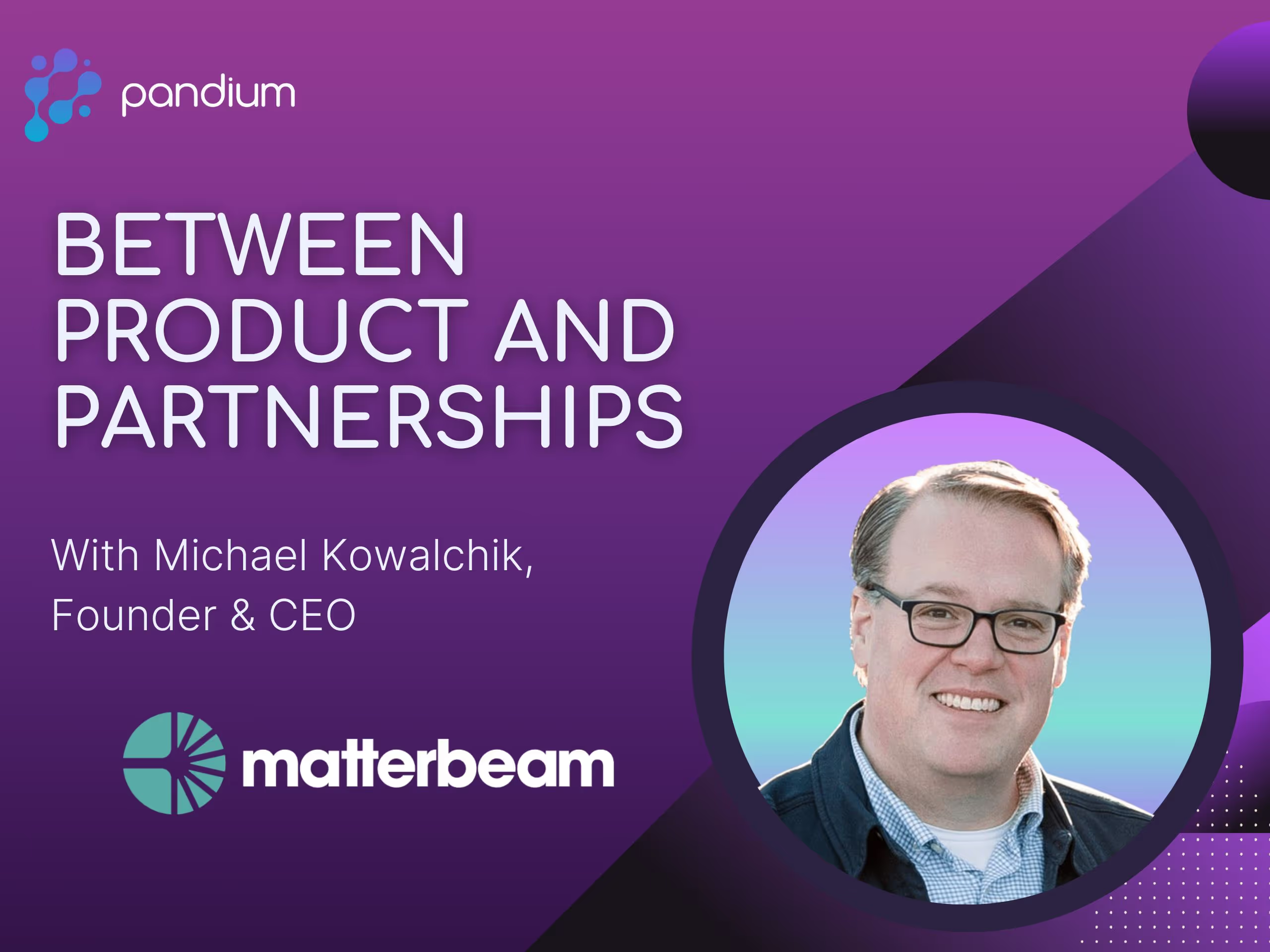
In this episode of Between Product and Partnerships, Cristina Flaschen speaks with Michael Kowalchik, founder and CEO of Matterbeam, about the structural challenges that make data integration so difficult and why many organizations still struggle to make their data usable. With over 25 years of experience across startups, research labs, and machine learning, Michael offers a seasoned view on a problem that has persisted through multiple generations of technology.
From Early Machine Learning to a Company-Wide Data Problem
Michael’s early startup, Smarterer, built adaptive assessment models using Bayesian machine learning. After the company was acquired by Pluralsight, he entered an environment that looked data-forward but was fragmented underneath. Even with strong teams and modern tools, the organization couldn’t reliably deliver the data its teams needed, revealing deeper architectural faults in how information moved across the business.
Why Traditional Data Architectures Break Down
As Michael examined Pluralsight’s systems, he saw issues familiar to many scaling companies. Acquisitions added new stacks and schemas, definitions varied from team to team, and pipelines became bottlenecks. Even simple requests took months. What should have been a strategic advantage instead slowed down product development and analytics. The problem wasn’t the people or tools; it was the outdated assumptions behind traditional data integration.
Building the Data Vascular System
Michael introduced a new architectural model based on immutable logs and replayable streams rather than centralized pipelines. This let teams subscribe to consistent data flows and materialize information as needed without forcing uniform structures. Pluralsight referred to it as the "data vascular system" because it connected the entire business. It led to significant gains, from faster data access to shorter product development cycles, proving that a more flexible, resilient design was possible.
The Birth of MatterBeam
Matterbeam grew from Michael’s belief that the industry needed a practical alternative to concepts like data mesh. Many teams agreed with the problems data mesh highlighted but struggled to make it work. Matterbeam provides decentralized data access with centralized governance, allowing organizations to adapt to real-world complexity while keeping visibility and control. The architecture supports analytics, product needs, and emerging AI workflows.
Why AI Cannot Fix a Broken Data Foundation
Cristina and Michael discuss the misconception that AI agents can resolve underlying data issues. Michael explains that if humans cannot trust or access the data feeding their systems, AI will struggle even more. Variability, opacity, and inconsistent outputs make AI a poor substitute for a strong foundation. Cristina notes that user-defined fields and inconsistent inputs still require thoughtful transformation, and generative models are not naturally suited for that work. Both emphasize that AI depends on stable, traceable data, not shortcuts around it.
Rethinking Data Quality and Domain Definitions
Michael reframes data quality as a matter of understanding domain differences rather than forcing every team into a single definition. Using domain-driven design principles, he encourages organizations to maintain distinct domains while creating clear and transparent outputs that meet broader business needs. Attempts to unify everything often lead to oversized schemas and brittle models, while a flexible, observable transformation layer builds long-term trust.
Preparing for the Future of Migrations and AI Infrastructure
Matterbeam is increasingly focused on improving data migrations, an area known for being slow and risky. Treating data as a utility rather than a collection of pipelines helps organizations move faster and reduces operational load. This approach also supports AI systems that require reliable, governed access without unpredictable delays or heavy token usage. MatterBeam’s upcoming webinar will explore these ideas further.
Closing Thoughts
Cristina closes by noting how Michael’s work reflects the challenges facing many SaaS companies navigating growth and increasing system complexity. Modern tools alone cannot solve structural weaknesses. True data maturity requires rethinking how information flows, ensuring clarity, transparency, and adaptability at every layer.
Connect with the Speakers
Connect with Cristina: www.linkedin.com/in/cristina-flaschen/
Connect with Michael: www.linkedin.com/in/mikepk/
Learn more about Matterbeam at matterbeam.com
Register for their webinar, Data Migration Without the Risk, at matterbeam.com/webinar.
--
This podcast is hosted by Pandium, the only embedded integration platform that facilitates faster code-first development of integrations, allowing B2B SaaS companies to launch integrations at scale without sacrificing customization and control.
Learn more about Pandium here: https://www.pandium.com/
To access more resources and content on technology partnerships, integrations, and APIs, check out our blog and resources page below.
Blog: https://www.pandium.com/blog
Resources on Technology Partnerships, Integrations, and APIs: https://www.pandium.com/ebooks

